
If you’re new to working out, it’s easy to feel like you’re behind before you even begin.
Social media makes it look like everyone has a home gym, perfect form, and unlimited motivation. Meanwhile, you might be standing in your living room thinking, “I don’t have equipment… so what am I supposed to do?”
Here’s the good news: you can build strength, stamina, and confidence with a beginner home workout without equipment. No dumbbells. No machines. No special setup. Just your bodyweight and a routine you can repeat.
This post gives you a complete beginner session you can do today: – a quick warm-up – a full-body no-equipment circuit (with beginner options) – a short finisher that won’t destroy your knees – a cool-down – a simple 4-week progression so you don’t stall after Week 1
Unspecified details: Your age range, medical history, and injuries are unspecified. This routine assumes a generally healthy adult beginner and includes modification options and a conservative “pain rule.”
Important note: This is general fitness information. If you have chest pain, dizziness, uncontrolled blood pressure, you’re pregnant or postpartum, or you’re recovering from an injury, ask a qualified health professional before starting.
► Table of Contents
WORKOUT AT A GLANCE (SAVE THIS)
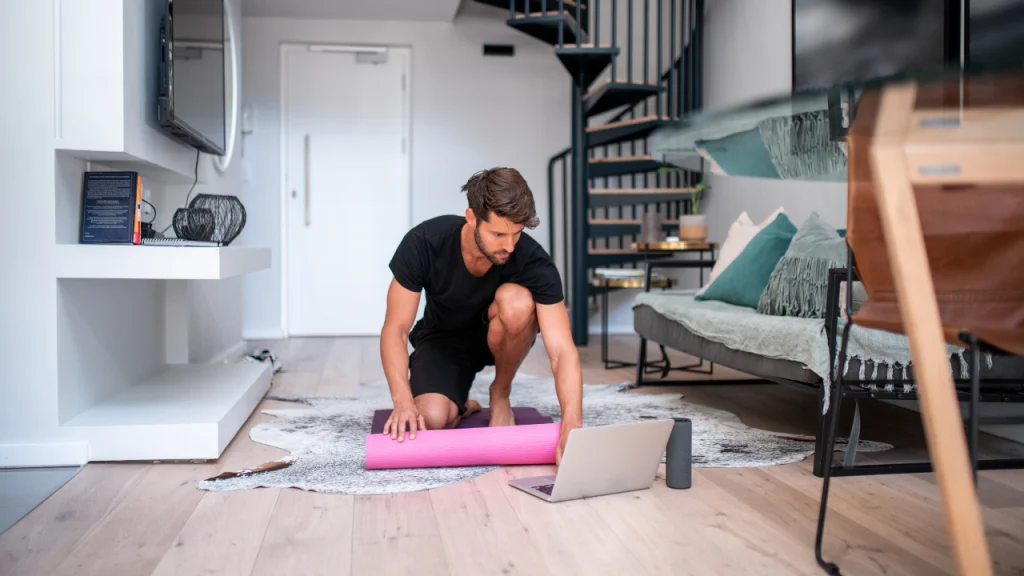
Primary keyword: beginner home workout without equipment
Time: about 20 minutes
Equipment: none required (a wall or chair can help as a support)
Workout style: full-body bodyweight circuit + optional finisher
Best for: true beginners, “getting back into it,” small spaces, low-impact preference
This session includes: – 4 minutes warm-up – 12 minutes main circuit (3 rounds) – 2 minutes optional finisher – 2 minutes cool-down
SAFETY AND WHO THIS WORKOUT IS FOR
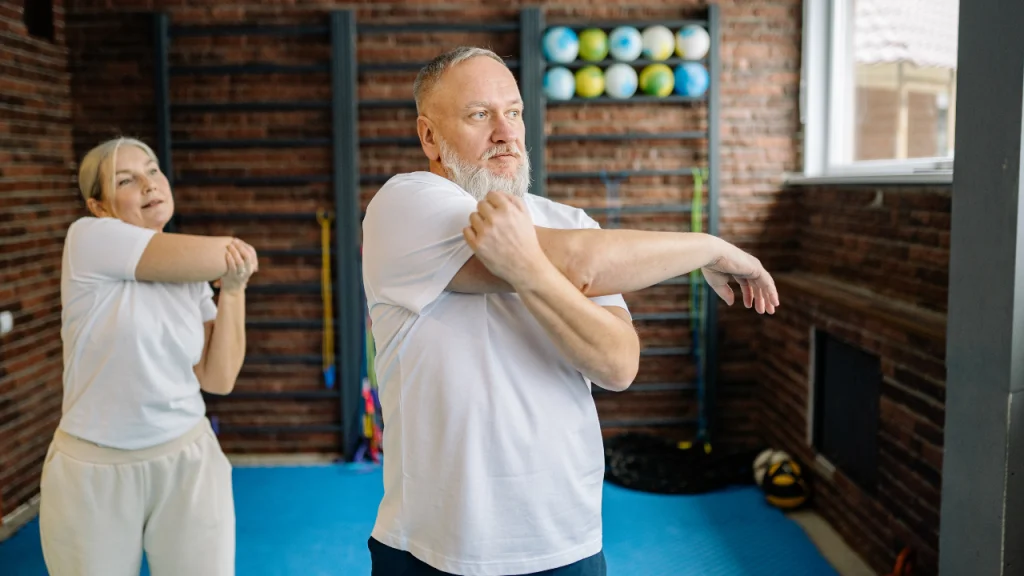
This beginner no equipment workout is for you if: – You haven’t exercised in a while (or ever) and want a clear starting point. – You want a full-body workout at home with no equipment. – You prefer a routine that doesn’t require jumping. – You want structure, but not a complicated plan.
You should modify the workout if: – Your knees or ankles don’t love impact (use the low-impact swaps). – Your wrists get cranky (use wall/counter versions or forearms when possible). – Your low back is sensitive (use smaller range of motion and slower tempo).
Pain rule (simple and useful): – Muscle effort and fatigue can be normal. – Sharp pain, pinching, numbness/tingling, or dizziness is a stop sign.
The goal of a beginner home workout without equipment is not to “survive.” It’s to finish feeling capable enough to come back in two days.
Recommended Articles 👇
👉 The Hidden Vitamin and Mineral Gaps That Might Be Blocking Your Weight Loss
👉 You Have This Resistance; That’s Why You’re Not Losing Weight.
👉 Exercise and Weight Loss: Building an Effective Fitness Routine
WHY THIS WORKS WITHOUT EQUIPMENT
No equipment doesn’t mean “no resistance.” Your bodyweight is the resistance.
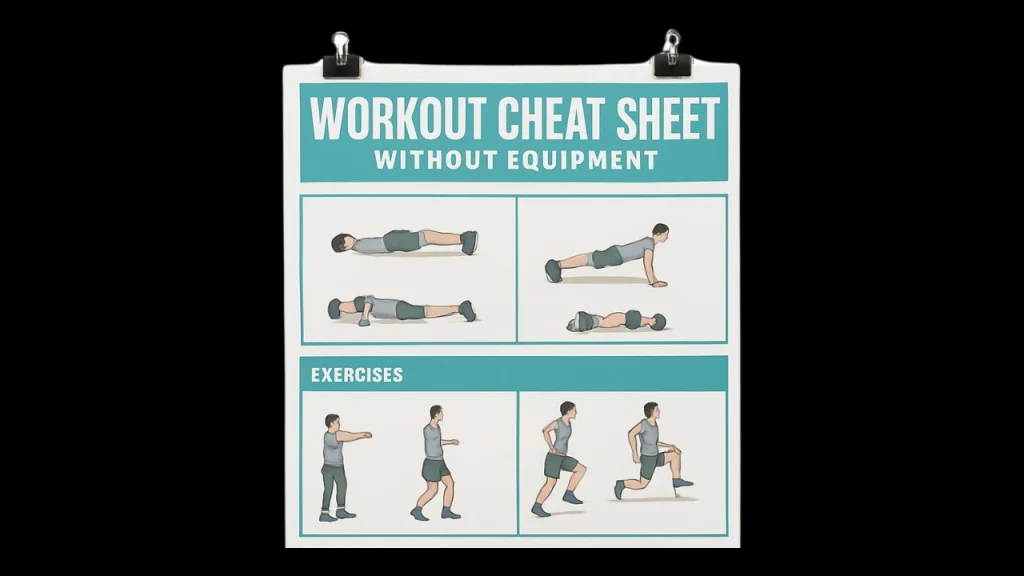
A smart beginner bodyweight workout trains a handful of movement patterns: – Squat (sit-to-stand) – Push (push-up progression) – Hinge or bridge (glutes/hamstrings) – Lunge (single-leg strength and balance) – Brace (core stability)
Your progress comes from gradually making one thing harder at a time. SERP-leading training guides consistently point to simple progressions: do more reps, reduce rest, choose slightly harder variations, or slow down the lowering phase. That’s “progressive overload” in beginner language.
Here’s what “progress” looks like in real life: – Week 1: You use the wall for push-ups and keep squats shallow. – Week 2: You move to a counter push-up and sit to a slightly lower chair. – Week 3: You need less rest between exercises. – Week 4: Your form feels steadier, and you recover faster.
That’s the win.
HOW HARD SHOULD A BEGINNER WORK OUT?
For beginners, consistency matters more than intensity.
A practical benchmark: Adults are generally recommended to accumulate at least 150 minutes per week of moderate-intensity activity and do muscle-strengthening activity at least 2 days per week.[1] You don’t need to hit that perfectly on Day 1. But it’s a helpful “north star” as you build the habit.
Two beginner-friendly ways to judge effort:
Talk Test: – Moderate intensity: you can talk, but not sing. – Vigorous intensity: you can’t say more than a few words without pausing for breath.
RPE (Rate of Perceived Exertion) 0–10 scale: Cleveland Clinic describes RPE as a tech-free way to gauge how hard your body feels like it’s working, based on breathing, fatigue, sweating, and effort.
For this beginner home workout without equipment: – Most exercises: aim for RPE 5–7 (challenging but controlled). – Finisher: brief push to RPE 7–8 (optional).
If you’re brand new: Start at RPE 4–6 for the first week. You’re building skill and habit.
WHAT YOU NEED (SPACE + SETUP)
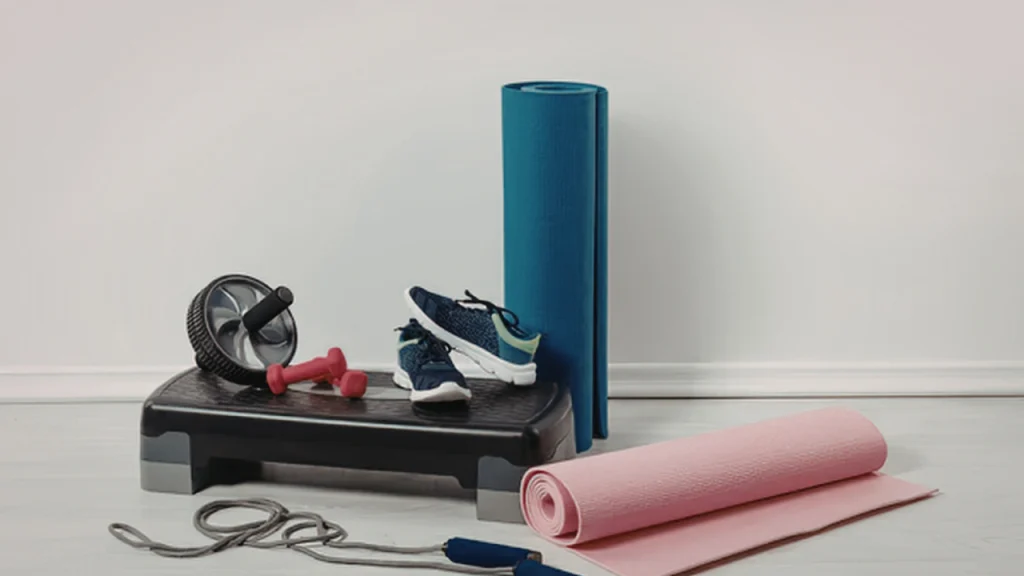
You need: – A small, clear space where you can stand, step back, and lie down. – A timer (phone timer is fine). – Comfortable shoes OR barefoot if your flooring is safe and stable.
Optional supports (still “no equipment” in the gym sense): – A wall (for wall push-ups) – A sturdy chair (for sit-to-stand squats or balance support)
Many popular no-equipment circuit workouts still mention optional basics like a chair or mat for comfort and modifications.[6]
WARM-UP (4 MINUTES)
Do each for about 40 seconds at an easy pace: 1) March in place + arm swings
2) Step jacks (no jumping)
3) Hip hinge “good mornings” (hands on hips, push hips back)
4) Shoulder circles + squeeze shoulder blades gently down and back
Warm-up rule: You should feel warmer and looser. You should not feel tired yet.
THE WORKOUT: BEGINNER HOME WORKOUT WITHOUT EQUIPMENT (20 MINUTES)
You’ll do a circuit of 6 exercises. Each round is 4 minutes. You’ll do 3 rounds total.
Option A: Timed circuit (simple and beginner-friendly) – 40 seconds work – 20 seconds rest/transition
Option B: Sets and reps (classic beginner formatting) Healthline’s beginner routine prescription is a good reference point: 2 sets of 10–15 reps with 30–60 seconds rest between moves, taking about 15–20 minutes.[4]
Choose the style you’ll actually repeat.
Form rule: If your reps get sloppy, slow down, shorten range, or rest. Clean reps beat fast reps.
MAIN CIRCUIT (3 ROUNDS, 12 MINUTES TOTAL)
Exercise 1: Chair Squat / Sit-to-Stand
Targets: legs, glutes, core
How: – Stand in front of a chair. – Sit back until you lightly touch the chair, then stand tall. – Keep feet flat and chest proud.
Make it easier: – Use a higher chair. – Reduce depth.
Make it harder: – Pause 1 second just above the chair. – Slow the lowering phase to 3 seconds.
Beginner mindset: If today’s win is “I did controlled sit-to-stands for 40 seconds,” that’s a win.
Exercise 2: Wall Push-Up or Counter Push-Up
Targets: chest, shoulders, triceps, core
How: – Hands on a wall (easiest) or counter (harder). – Body in a straight line. – Lower chest toward the wall/counter, then press away.
Make it easier: – Use a wall and stand more upright.
Make it harder: – Use a lower surface. – Slow the lowering phase. – Pause briefly near the wall/counter.
If you “can’t do push-ups”: That’s exactly why progressions exist. Wall → counter → knees → floor.[5]
Exercise 3: Glute Bridge
Targets: glutes, hamstrings, core control
How: – Lie on your back, knees bent, feet flat. – Squeeze glutes to lift hips. – Pause 1 second at the top, lower with control.
Make it easier: – Lift halfway and focus on glute squeeze.
Make it harder: – Hold the top for 2 seconds. – Add a slow tempo (3 seconds up, 3 seconds down).
Tip: If you mostly feel your low back, reduce range and slow down.
Exercise 4: Step-Back Lunge (or Supported Split Squat)
Targets: legs, glutes, balance
How: – Step one foot back. – Lower gently. – Push through the front foot to stand. – Alternate legs.
Make it easier: – Hold a wall or chair lightly. – Reduce depth. – Do a split squat without stepping (stay in place).
Make it harder: – Add a pause at the bottom. – Slow down.
Knee-friendly cue: Smaller step + controlled range usually feels better than a huge lunge.
Exercise 5: Bird Dog
Targets: deep core, glutes, spinal stability
How: – On hands and knees. – Extend opposite arm and leg slowly. – Pause, return, switch.
Make it easier: – Move only the arm, then only the leg. – Keep the lift lower.
Make it harder: – Pause longer. – Add a slow elbow-to-knee crunch under the torso, then re-extend.
Form cue: Keep hips level—think “steady table,” not “wobbling.”
Exercise 6: Prone W or Standing W (Upper Back)
Targets: upper back, posture muscles, rear shoulders
Floor version (Prone W): – Lie face down. – Elbows down and back in a “W.” – Gently lift hands/elbows slightly while squeezing shoulder blades. – Hold 1–2 seconds, lower.
Standing version (if floor isn’t comfy): – Stand against a wall. – Elbows bent, squeeze shoulder blades down and back for controlled reps.
Why this matters: Many beginner routines include squats and push-ups but forget upper-back work. This keeps shoulders and posture more balanced.
OPTIONAL 2-MINUTE FINISHER
Choose one: – Marching high knees (quiet and controlled) – Shadow boxing (light, fast punches) – Step jacks (no jump)
Format: 20 seconds moderate pace
10 seconds a little faster
Repeat until 2 minutes
Goal: Finish warm and slightly breathy, not wrecked.
COOL-DOWN (2–3 MINUTES)
- Slow walk in place + long exhales (about 60 seconds)
- Hip flexor stretch (30 seconds each side)
- Chest opener stretch (20–30 seconds)
Cool-down tip: If you feel lightheaded after effort, walk and breathe first before sitting down.
LOW-IMPACT SWAPS (QUIET, JOINT-FRIENDLY)
If you want this beginner home workout without equipment to be easier on knees and ankles, use these swaps:
- Jumping jacks → step jacks
- Running high knees → marching high knees
- Burpees → walkout to plank (no jump)
- Jump squats → squat + calf raise
- Fast mountain climbers → hands-elevated knee drives
HOW OFTEN SHOULD YOU DO THIS WORKOUT?
Most beginners do best with a schedule that respects recovery.
Two evidence-aligned anchors: – CDC recommends adults aim for 150 minutes/week of moderate-intensity activity and muscle strengthening 2 days/week.[1] – Mayo Clinic notes strength exercises for major muscle groups at least twice/week, and to avoid training the same muscle group two days in a row; it also notes that one set can be enough for benefits when resistance fatigues muscles around 12–15 reps.[7]
A practical beginner schedule: – 2–3 sessions/week of this routine (leave a day between) – easy walking or mobility on other days
Examples:
Option A (2 days/week, very sustainable) – Monday: workout – Thursday: workout – Other days: 10–30 minutes walking if you can
Option B (3 days/week, faster progress) – Monday: workout – Wednesday: workout – Friday: workout – Other days: walking or mobility
If you’re sore: Do the easier version next time (less depth, fewer rounds, more rest), or swap to walking. Soreness is common early on but isn’t required for progress.
SIMPLE 4-WEEK PROGRESSION (BEGINNER-FRIENDLY)
Week 1: Learn the movements – Do 2 rounds – Use 30 seconds work / 30 seconds rest
Week 2: Build consistency – Do 3 rounds – Keep the easy timing OR move to 40/20 if you feel ready
Week 3: Build capacity – 3 rounds at 40/20 – Reduce rest between rounds slightly (only if form stays clean)
Week 4: Upgrade one thing Pick one upgrade: – Wall push-up → counter push-up – Chair squat → slightly deeper squat – Add slow tempo (3 seconds down) on squats and lunges
COMMON BEGINNER MISTAKES (AND QUICK FIXES)
Mistake: Starting too hard
Fix: Start easier than you think. Your goal is repeatability.
Mistake: Rushing reps
Fix: Slower reps build control and confidence.
Mistake: Skipping rest and recovery
Fix: Rest days are part of training. You improve between workouts.
Mistake: Thinking “short workouts don’t count”
Fix: A consistent 10–20 minute routine can build real momentum. Health-focused organizations also highlight short, accessible home workouts as a practical way to get active.[8]
FOLLOW-ALONG VIDEOS
Nerd Fitness beginner bodyweight circuit (aligned with their article):
No-jumping, no-equipment beginner routine:
FAQ: BEGINNER HOME WORKOUT WITHOUT EQUIPMENT
Can a beginner really get results without equipment?
Yes. Bodyweight training can build strength and fitness because you can progressively increase difficulty by changing reps, rest, tempo, or exercise variations.[5]
How long should a beginner no-equipment workout be?
Many beginners do well starting with 10–20 minutes. Healthline’s beginner routine example is designed to take about 15–20 minutes, and that’s a solid starting target.[4]
How often should I do this routine?
A common beginner approach is 2–3 times per week with rest days between. Nerd Fitness suggests 2–4 times per week and taking about 48 hours off between strength sessions.[5] Mayo Clinic advises training major muscle groups at least twice a week and not training the same muscle group two days in a row.[7]
What if I can’t do push-uPS?
Start with wall push-ups. Then progress to counter push-ups. Then knee push-ups. Then floor push-ups. That progression is normal and is exactly how many beginner plans teach the movement.[5]
What if I need low impact (no jumping)?
Use step jacks, marching high knees, and hands-elevated knee drives. You can get a great workout without impact by moving continuously at a moderate pace.[6]
How do I know I’m working hard enough?
Use the Talk Test: moderate intensity means you can talk but not sing; vigorous means you can’t say more than a few words without pausing.[2] You can also use an RPE 0–10 scale, which Cleveland Clinic describes as a practical way to rate effort.[3]
What should I do after 4 weeks?
Repeat the 4 weeks with slightly harder variations, or move into a beginner plan that adds variety (like an A/B full-body split) so you keep progressing.
NEXT STEP
Do this beginner home workout without equipment once.
Then schedule your next session.
The routine that gets repeated is the routine that works.
- https://www.mayoclinic.org/healthy-lifestyle/fitness/basics/strength-training/hlv-20049447?utm_source=chatgpt.com
- https://www.healthline.com/health/fitness-exercise/at-home-workouts
- https://www.nerdfitness.com/blog/beginner-body-weight-workout-burn-fat-build-muscle/
- https://calisthenics.com/workout-plan/full-body-home-workout-plan-for-beginners-no-equipment/
- https://www.anytimefitness.com/blog/no-equipment-necessary-the-at-home-circuit-workout-you-can-do-anywhere
- https://www.cdc.gov/physical-activity-basics/measuring/index.html?utm_source=chatgpt.com
- https://www.nhs.uk/better-health/get-active/home-workout-videos/?utm_source=chatgpt.com
- https://www.nerdfitness.com/blog/the-7-best-at-home-workout-routines-the-ultimate-guide-for-training-without-a-gym/
- https://www.cdc.gov/physical-activity-basics/guidelines/adults.html?utm_source=chatgpt.com
- https://www.who.int/initiatives/behealthy/physical-activity?utm_source=chatgpt.com
- https://www.youtube.com/watch?v=qvhHhDNjtxM&utm_source=chatgpt.com
- https://www.youtube.com/watch?v=9eujZ6FJF0M&utm_source=chatgpt.com
- https://my.clevelandclinic.org/health/articles/17450-rated-perceived-exertion-rpe-scale?utm_source=chatgpt.com
