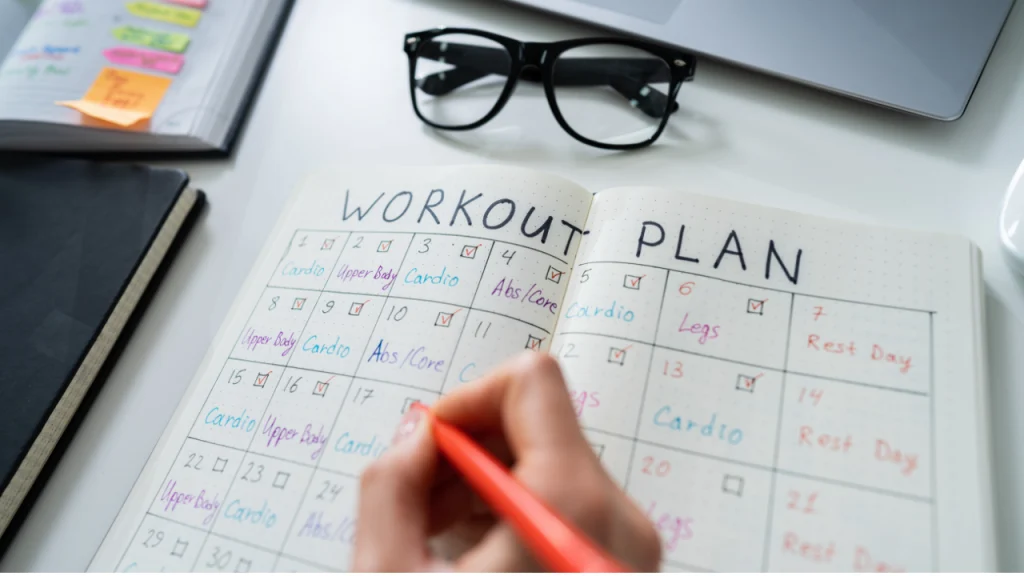

If you’re starting from scratch, you don’t need a complicated routine. You need a plan you can repeat, a way to know you’re doing “enough,” and a structure that keeps you from going too hard on Day 1 and quitting on Day 5.
This beginner home workout plan is built for real life: limited time, limited space, and a body that might be a little stiff right now. You’ll train your whole body, build basic strength, improve stamina, and (most importantly) prove to yourself that you can stay consistent.
IMPORTANT SAFETY NOTE (please read): If you have chest pain, dizziness, uncontrolled blood pressure, are pregnant/postpartum, have a medical condition, or are recovering from an injury, check with a qualified healthcare professional before starting. During workouts, stop if you feel sharp pain, dizziness, or anything that feels “wrong.”
► Table of Contents
Quick Start (Your Home Workout Plan at a Glance)
Time per workout: 20–35 minutes
Days per week: 4 structured days (2 strength + 2 cardio), plus optional easy movement
Equipment: None required (a sturdy chair and a towel help). Optional: resistance band or light dumbbells/backpack.
Fitness level: True beginner to “getting back into it”
Goal: Build a base of strength, mobility, and cardio fitness you can keep improving.
Who This Home Workout Plan Is For
This plan is for you if: – You want a clear beginner workout plan at home (not a random list of exercises). – You don’t want to jump a lot (or you live in an apartment). – You want to get stronger without spending hours in the gym. – You want a routine you can scale up or scale down.
This plan is NOT ideal if: – You want a bodybuilding-style split with lots of equipment. – You need a highly specialized rehab program (you’ll want a clinician or qualified coach).
How Hard Should a Beginner Work Out at Home?
Here’s the honest truth: beginners don’t need “destroy yourself” workouts. Beginners need repeatable workouts.
Use these two simple intensity checks:
1) The Talk Test (easy cardio guidance)
During moderate-intensity cardio, you should be able to talk but not sing. If you can only get out a few words before needing a breath, you’re in vigorous intensity.
2) RPE (Rate of Perceived Exertion) on a 0–10 scale
RPE is how hard the effort feels to you. Cleveland Clinic describes this as a subjective scale from 0 to 10 used to gauge intensity.
For this plan, aim for: – Strength days: RPE 6–7 on your last few reps (challenging, but controlled) – Cardio circuit day: mostly RPE 5–7 – Steady cardio day: RPE 4–6 (conversational pace)
Translation: you should finish feeling like you did something, not like you got hit by a truck.
What You Need (Equipment + Space)
You can follow this home workout plan with zero equipment.
Helpful “household gym” upgrades: – A sturdy chair (for supported squats, incline push-ups, step-ups) – A towel (for sliding hamstring curls on tile/wood, or for gentle “towel row” variations) – A backpack you can load with books (great for rows and hinges) – Optional: a resistance band (huge value for rows and glute work)
Space checklist: – Enough room to lie down and extend your arms and legs – A non-slip surface (or exercise mat) – A clear area with no loose rugs or clutter
Warm-Up and Cool-Down (Don’t Skip These)
Warm-up (3–5 minutes)
Do each for about 20–30 seconds: – March in place – Arm circles (small to bigger) – Hip circles – Bodyweight “good mornings” (hands on hips, hinge slightly) – 5–8 slow chair squats (easy range) – 20-second plank on knees (optional)
Cool-down (3–5 minutes)
Breathe slowly and stretch what feels tight: – Calf stretch against a wall – Quad stretch (hold a chair for balance) – Chest opener (hands clasped behind back, gentle) – Child’s pose or a gentle forward fold (if comfortable)
The Weekly Schedule (Beginner-Friendly and Sustainable)
Public-health guidelines commonly recommend at least 150 minutes of moderate-intensity aerobic activity per week plus muscle-strengthening work at least 2 days/week.
This plan helps you work toward that in a realistic way.
Here’s the weekly structure you’ll repeat for 4 weeks:
Day 1: Strength Workout A (Lower body + push + core)
Day 2: Low-Impact Cardio Circuit (plus light core)
Day 3: Rest or easy walk (10–30 minutes)
Day 4: Strength Workout B (Lower body + pull + core)
Day 5: Steady Cardio (20–35 minutes at conversational pace)
Day 6: Rest or mobility/stretch (10–20 minutes)
Day 7: Rest (or an easy walk)
If you only have 3 days/week, do Day 1, Day 4, and Day 5. That’s a strong beginner setup.
The Workouts (What to Do Each Day)
How to read strength workouts: – Rest 45–90 seconds between sets. – Move slowly enough to feel control. – If you’re not sure what to choose: pick the easier variation in Week 1. Earn the harder version later.
Strength Workout A (20–30 minutes)

A1) Chair Squat or Bodyweight Squat
– Week 1: 2 sets x 8–10 reps
– Weeks 2–3: 3 sets x 8–12 reps
– Week 4: 3 sets x 10–12 reps (slightly shorter rest)
Form cue: keep your chest proud, push the floor away, knees track roughly over toes.
A2) Incline Push-Up (hands on a counter/bench) OR Wall Push-Up
– Week 1: 2 sets x 6–8 reps
– Weeks 2–3: 3 sets x 6–10 reps
– Week 4: 3 sets x 8–10 reps
Form cue: ribs down, body in a straight line—don’t lead with your chin.
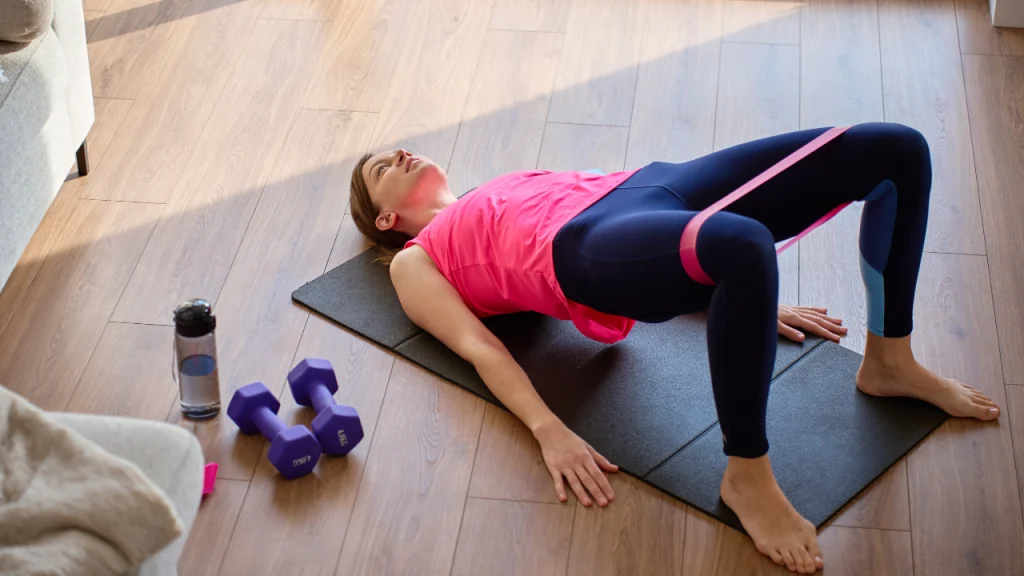
A3) Glute Bridge
– Week 1: 2 sets x 10–12 reps
– Weeks 2–3: 3 sets x 10–15 reps
– Week 4: 3 sets x 12–15 reps (pause 1 second at the top)
Form cue: squeeze glutes at the top; don’t over-arch your low back.
A4) Dead Bug (core) OR Bird Dog
– Week 1: 2 sets x 6–8 reps per side
– Weeks 2–3: 3 sets x 6–10 reps per side
– Week 4: 3 sets x 8–10 reps per side
Form cue: move slowly; keep your torso stable like you’re balancing a glass of water.
Optional finisher (Week 2–4 only):
– March in place, brisk pace: 2 rounds x 30–45 seconds
Low-Impact Cardio Circuit Day (20–25 minutes)
Pick 6–8 moves from this list, then run them as a circuit:
- March in place (strong arm swing)
- Step jacks (no jumping)
- Shadow boxing (light and fast)
- Low skater steps (tap side to side)
- Reverse lunge to knee drive (slow, controlled)
- Inchworm walkout (short range is fine)
- Plank shoulder taps (on knees if needed)
- Glute bridge march
- “Fast feet” in place (quiet, short steps)
Timing by week: – Week 1: 30 seconds work / 20 seconds easy pace (or rest) x 2 rounds
– Week 2: 35 seconds work / 20 seconds easy pace x 2–3 rounds
– Week 3: 40 seconds work / 20 seconds easy pace x 2–3 rounds
– Week 4: 45 seconds work / 15–20 seconds easy pace x 3 rounds
Beginner win condition: You finish slightly sweaty, breathing harder, but you could still recover within a couple of minutes.
Add 3–5 minutes of light core (optional): – Side plank on knees: 2 x 15–25 seconds each side
– Or plank on knees: 2 x 20–30 seconds
Strength Workout B (20–35 minutes)
B1) Reverse Lunge (step-back) OR Supported Split Squat (hold a chair)
– Week 1: 2 sets x 6 reps per leg
– Week 2: 3 sets x 6–8 reps per leg
– Week 3: 3 sets x 8–10 reps per leg
– Week 4: 3 sets x 8–10 reps per leg (shorter rest)
Form cue: small step back, tall torso, front foot stays planted.
B2) Hip Hinge (Good Morning) OR Romanian Deadlift with Backpack
– Week 1: 2 sets x 10 reps
– Week 2: 3 sets x 10 reps
– Week 3: 3 sets x 12 reps
– Week 4: 3 sets x 12–15 reps
Form cue: push your hips back like you’re closing a drawer with your butt; keep back neutral.
B3) Row (choose one)
Option 1: Backpack Row (bent over, flat back)
Option 2: Band Row (if you have a resistance band)
Option 3: Towel “Isometric Row” (wrap towel around something sturdy, pull and hold)
- Week 1: 2 sets x 8–10 reps (or 10–20 second holds)
- Weeks 2–3: 3 sets x 8–12 reps
- Week 4: 3 sets x 10–12 reps
Why rows matter: beginners often do “push” moves (push-ups) but skip pulling. Rows help balance shoulders, posture, and upper back strength.
B4) Wall Sit OR Calf Raises
– Week 1: 2 x 20–30 seconds (wall sit) or 2 x 12 reps (calf raises)
– Week 2–4: 2–3 sets, gradually increase time/reps
Steady Cardio Day (20–35 minutes)
Pick one: – Brisk walk outside
– Walk indoors (stairs, hallway laps, or a walking workout video)
– Easy cycling
– Low-impact dance
Intensity goal: conversational pace (Talk Test “talk but not sing”).
Progression: – Week 1: 20 minutes
– Week 2: 25 minutes
– Week 3: 30 minutes
– Week 4: 30–35 minutes
The 4-Week Progression Rules (How You’ll Get Results)
Beginner progress comes from doing the basics consistently, then gently making them harder.
Here’s how you’ll progress: – First, you learn the movement. – Then, you add a little volume (more reps or an extra set). – Then, you reduce rest slightly or try a harder variation.
Practical progression tips: – If you can easily do your top reps with perfect form, add 1–2 reps next session. – If your form breaks, stop the set. “Messy reps” don’t help beginners. – If you’re sore, keep the plan but reduce volume (do 2 sets instead of 3).
Common Beginner Mistakes (And How to Avoid Them)
Mistake: Doing too much in Week 1
Fix: Treat Week 1 as practice. You’re building the habit and the form.
Mistake: Only doing cardio (or only doing strength)
Fix: A balanced beginner routine includes both. That’s why this home workout plan alternates strength and cardio days.
Mistake: Going hard every day
Fix: Rest days are part of the plan. Many structured beginner programs explicitly build in rest and recovery so you don’t burn out.
Mistake: Not knowing what “hard enough” means
Fix: Use the Talk Test for cardio and RPE for strength.
Recovery Basics (So You Can Stick With It)
Expect some soreness in the first 1–2 weeks. That’s normal, especially if you’re new to strength work.
What helps: – Easy walks on rest days – Hydration – Protein with meals – Sleep
If soreness is sharp, gets worse, or changes how you walk/move, stop and get professional guidance.
FAQs About a Beginner Home Workout Plan
What’s the best schedule for a home workout plan for beginners?
A simple weekly rhythm most beginners can sustain is 2 strength days plus 2 cardio days, with rest or light movement between sessions. That structure shows up in beginner plans that rank well because it balances muscle work, heart health, and recovery.
What if I only have 10 minutes?
Do a “mini session” and keep the habit alive. Some ranking plans explicitly recommend splitting sessions into shorter blocks and letting short bouts add up.
Try this 10-minute mini circuit:
– 8 chair squats
– 6 incline push-ups
– 10 glute bridges
– 20–30 seconds marching in place
Repeat 2–3 rounds at an easy pace.
Q: How do I know I’m working hard enough?
A: Use the Talk Test for cardio and RPE for strength. At moderate intensity you can talk but not sing; at higher intensity you can only say a few words before breathing.
For strength, aim for RPE ~6–7 on hard sets (challenging but controlled), using the 0–10 concept described by Cleveland Clinic.
Do I need equipment for this home workout plan?
No. You can get a strong beginner plan with bodyweight only. If you later want to level up, a mat, resistance band, or adjustable dumbbells can expand your options—but they’re not required to start.
When will I see results?
Many beginners notice improvements in energy, stamina, and confidence within a few weeks if they stay consistent. Visible body-composition changes often take longer and depend on sleep and nutrition too—so focus on consistency first.
Your Next Step
If you’re ready, pick your start date and do Week 1 exactly as written. After 7 days, your main job is simple: show up again.
If you want to make this even easier, create a recurring calendar reminder for your workout days—like an appointment you don’t cancel.
- https://www.zing.coach/fitness-library/home-workout-plan-for-beginners
- https://www.bodyspec.com/blog/post/home_workout_for_beginners_4week_plan
- https://fitnessvolt.com/beginner-home-workout-program/
- https://calisthenics.com/workout-plan/full-body-home-workout-plan-for-beginners-no-equipment/
- https://www.cdc.gov/physical-activity-basics/guidelines/adults.html
- https://www.cdc.gov/physicalactivity/basics/measuring/index.html
- https://my.clevelandclinic.org/health/articles/17450-rated-perceived-exertion-rpe-scale
- https://www.who.int/initiatives/behealthy/physical-activity?utm_source=chatgpt.com
- https://www.nourishmovelove.com/fitness-beginner-workout-plan/
