
If you’ve ever searched “home workout routine” and immediately felt overwhelmed… you’re not alone.
A lot of routines online are either: – too long, – too intense, – too complicated, – or they assume you already know what you’re doing.
This article is different. It’s built for real beginners.
You’ll get a simple home workout routine you can repeat week after week—with clear workouts, recovery days, and a progression plan so you keep improving.
Unspecified details: Your age, medical history, and injuries are unspecified, so this routine assumes a generally healthy adult beginner and includes low-impact options and a “pain rule.”
Important note: This is general fitness information, not medical advice. If you have chest pain, dizziness, uncontrolled blood pressure, you’re pregnant/postpartum, or you’re recovering from an injury, consult a qualified healthcare professional before starting.
► Table of Contents
HOME WORKOUT ROUTINE AT A GLANCE (SAVE THIS)
Schedule: 3 days/week strength + optional light cardio on off days
Time per workout: 20–35 minutes
Equipment: no equipment required (optional: chair, backpack, towel)
Style: full-body strength training + simple conditioning
Best for: beginners, “getting back into it,” busy schedules, home training
Effort target: – You should finish feeling worked, not wrecked. – Most sets should feel “challenging but controlled.”
SAFETY + WHO THIS ROUTINE IS FOR
This home workout routine is for you if: – you want a beginner plan that’s simple and repeatable – you want full-body training without a gym – you want a routine that improves strength and stamina over time
Modify the routine if: – jumping or fast moves bother your knees/ankles (use the low-impact options) – wrist discomfort makes planks/push-ups hard (use wall/counter variations) – low back sensitivity flares up (shorten range and slow down)
Pain rule: – muscle fatigue and a mild burn can be normal – sharp pain, pinching, dizziness, numbness/tingling is a stop sign
Recommended Articles 👇
👉 The Hidden Vitamin and Mineral Gaps That Might Be Blocking Your Weight Loss
👉 You Have This Resistance; That’s Why You’re Not Losing Weight.
👉 Exercise and Weight Loss: Building an Effective Fitness Routine
WHY THIS IS THE BEST HOME WORKOUT ROUTINE FOR BEGINNERS
Beginners don’t need fancy exercises. They need fundamentals.
This routine focuses on the big movement patterns that give you the best results for your time: – squat (legs + glutes) – push (chest/shoulders/triceps) – hinge/bridge (glutes/hamstrings) – lunge (single-leg strength + balance) – core stability (bracing)
This matches what many beginner-focused routine builders recommend: keep it simple, prioritize compound patterns, and repeat them consistently so you improve. (That’s how you build confidence and real strength at home.)
HOW HARD SHOULD IT FEEL? (TALK TEST + SIMPLE RPE)
Use the Talk Test: – Moderate effort: you can talk, but not sing. – Vigorous effort: you can only say a few words before you need a breath.
Most of this beginner home workout routine should feel moderate, with short moments that feel harder.
Optional effort scale (RPE 0–10): – 0 = resting – 10 = max effort
Aim for: – Strength sets: RPE 6–7 (challenging but controlled) – Finisher/cardio bursts: RPE 7–8 (briefly), or keep it moderate if you prefer
If your form falls apart, you’re going too hard. Slow down and earn the next level.
YOUR 3-DAY WEEKLY HOME WORKOUT ROUTINE
This schedule is simple for beginners and gives recovery between strength days.
Week structure: – Monday: Workout A (Full Body Foundation) – Wednesday: Workout B (Full Body + Core) – Friday: Workout A again (or repeat Workout B next week)
Next week, swap: – Monday: Workout B – Wednesday: Workout A – Friday: Workout B
Why alternate? It keeps things from getting boring while still repeating the basics enough to progress.
Optional “off day” movement (recommended): – 10–30 minutes walking – gentle mobility / stretching – easy cycling
This helps you build toward the general public-health target of regular weekly activity while keeping strength days manageable.
WARM-UP (5 MINUTES)
Do this before every workout (it’s quick, and it helps your joints and form).
1) March in place – 60 seconds
2) Arm circles + shoulder rolls – 60 seconds
3) Hip circles – 30 seconds each direction
4) Chair squats (easy) – 8 reps
5) Wall push-ups (easy) – 6 reps
6) 20-second plank on knees or hands on a counter
Warm-up rule: You’re warming up, not trying to tire yourself out.
WORKOUT A: FULL BODY FOUNDATION (20–35 MINUTES)
Choose your format:
Option 1 (beginner classic): Sets + reps
– Do 2 sets per exercise in Week 1–2
– Move to 3 sets in Week 3–4
– Rest 45–75 seconds between sets
Option 2 (time-saving): Circuit style
– Do all exercises once (one round)
– Rest 60–90 seconds
– Repeat for 2–3 rounds
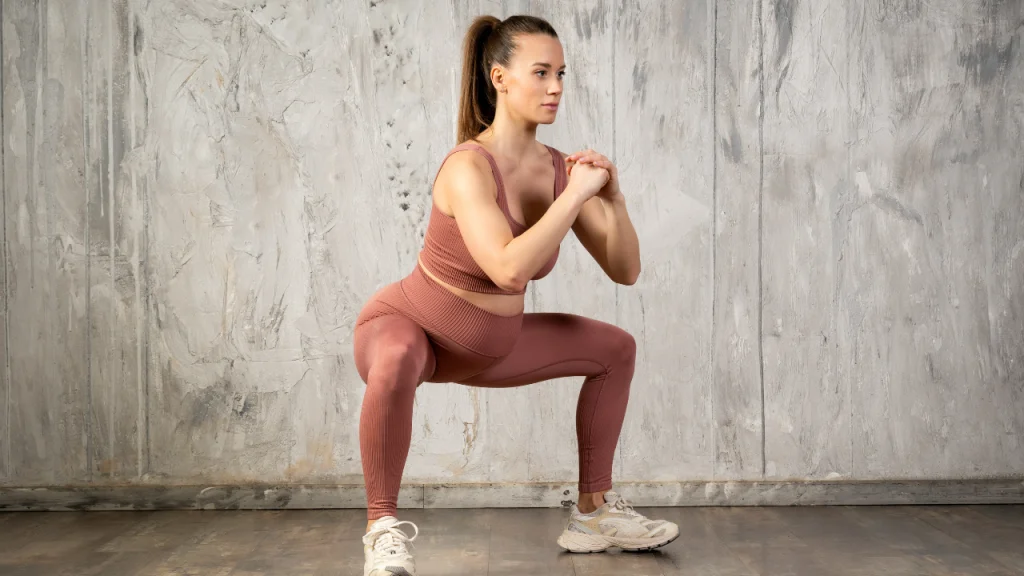
Exercise A1: Squat (Chair squat or bodyweight squat)
Sets/Reps: 2–3 sets of 8–12 reps
Form cues: – hips back like you’re sitting – chest tall – feet flat
Beginner option: – sit-to-stand from a chair
Make it harder: – slow down (3 seconds down) – pause briefly at the bottom
Exercise A2: Push-up progression (Wall → counter → knee → floor)
Sets/Reps: 2–3 sets of 6–12 reps
Beginner option: – wall push-ups (standing)
Make it harder: – use a lower surface – slow the lowering phase
Exercise A3: Hip hinge (Good mornings) OR Glute bridge
Sets/Reps: 2–3 sets of 10–15 reps
Good mornings: – hands on hips – push hips back – flat back – small range is fine
Glute bridge: – squeeze glutes – pause 1–2 seconds at the top
Exercise A4: “Pull” movement (pick one)
Because pulling is harder with no equipment, choose what you can do.
Option A: Backpack row
– load a backpack with books – hinge slightly – row to ribs
Option B: Towel isometric row
– sit tall – towel around feet – pull and hold tension 15–20 seconds (counts as a set)
Sets: 2–3 sets
Exercise A5: Core brace (Plank on knees or elevated plank)
Sets: 2–3 holds of 15–30 seconds
Form cues: – ribs down – squeeze glutes lightly – breathe (don’t hold your breath)
Workout A finisher (optional, 2 minutes): – marching high knees (quiet) – step jacks – shadow boxing
20 seconds moderate / 10 seconds a little faster, repeat for 2 minutes.
WORKOUT B: FULL BODY + CORE (20–35 MINUTES)
Format options are the same: – 2–3 sets per exercise with rest, OR – 2–3 rounds as a circuit
Exercise B1: Reverse lunge OR supported split squat
Sets/Reps: 2–3 sets of 6–10 reps per side
Beginner option: – hold a chair for balance – decrease depth
Knee-friendly tip: – smaller step – control the lowering
Exercise B2: Incline push-up (counter) OR wall push-up
Sets/Reps: 2–3 sets of 8–12 reps
Exercise B3: Glute bridge (or single-leg bridge later)
Sets/Reps: 2–3 sets of 12–15 reps
Exercise B4: Pull movement (same options as Workout A)
– backpack row OR towel row hold
Sets: 2–3 sets
Exercise B5: Core stability (Dead bug or plank)
Dead bug: 2–3 sets of 6–10 slow reps per side
Plank: 2–3 holds of 15–30 seconds
Workout B finisher (optional, 3 minutes): – 1 minute brisk march in place – 1 minute step jacks – 1 minute brisk march in place
Low-impact, but your heart rate will climb.
COOL-DOWN (3–5 MINUTES)
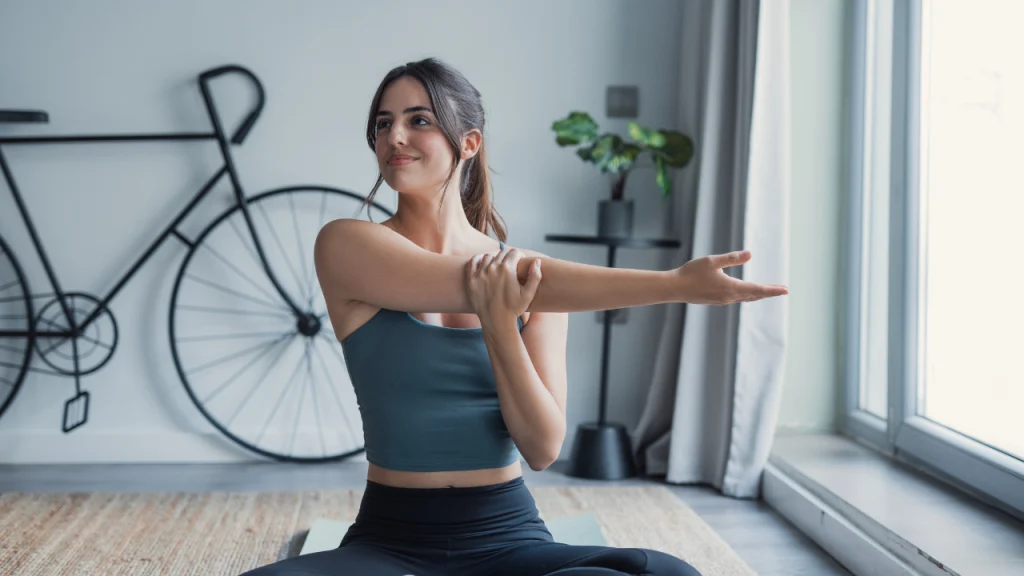
Do this right after each session: – slow walk in place + long exhales (60 seconds) – hip flexor stretch (30 seconds each side) – chest opener stretch (doorway or hands behind you) (30–45 seconds) – gentle forward fold or child’s pose (60 seconds)
Cool-down goal: Let your heart rate come down and help your body relax.
A SIMPLE 4-WEEK PROGRESSION (SO YOU KEEP IMPROVING)
Week 1: – 2 sets per exercise – choose easier variations – focus on form and finishing feeling good
Week 2: – 2 sets per exercise – improve one thing: slightly more reps or cleaner control
Week 3: – move to 3 sets for the first 2–3 exercises – or add a third round if you’re doing circuits
Week 4: – keep 3 sets / 3 rounds – upgrade one movement: – wall push-up → counter push-up – chair squat → deeper squat – slower tempo on squats and lunges – slightly less rest between rounds
A good beginner routine isn’t about constantly changing workouts. It’s about repeating the basics and getting better at them.
FOLLOW-ALONG VIDEOS
VIDEO: 20-minute full body beginner routine (no equipment)
VIDEO: 10-minute “living room workout” (beginner-friendly)
FAQ: HOME WORKOUT ROUTINE FOR BEGINNERS
How many days a week should a beginner do a home workout routine?
A common beginner approach is 2–3 strength-focused days per week with recovery days in between. Many guides recommend spacing strength days so you’re not training the same muscles on consecutive days.
Can I build muscle with a home workout routine?
Beginners can build strength and muscle at home by focusing on progressive overload—doing more reps, less rest, harder variations, or more control over time.
Do I need equipment?
No. This routine includes no-equipment options. If you have a backpack, towel, or sturdy chair, those can help you progress.
What if I only have 10 minutes?
Do one round of Workout A (squat, push, hinge/bridge, core) and keep it moving. Consistency beats perfection.
Is soreness required for progress?
No. Mild soreness can happen early on, but progress comes from repeating the routine and gradually improving performance.
What if lunges hurt my knees?
Shorten your range of motion, hold a chair for balance, and slow down. You can also prioritize squats and hip hinges while you build capacity.
- https://www.cdc.gov/physical-activity-basics/guidelines/adults.html
- https://www.nerdfitness.com/blog/how-to-build-your-own-workout-routine/
- https://www.setforset.com/blogs/news/full-body-at-home-workout-routine-for-beginners
- https://www.mayoclinic.org/healthy-lifestyle/fitness/basics/strength-training/hlv-20049447
- https://www.nerdfitness.com/blog/beginner-body-weight-workout-burn-fat-build-muscle/
- https://www.cdc.gov/physical-activity-basics/measuring/index.html
- https://www.pexels.com/license/
- https://www.healthline.com/health/fitness-exercise/at-home-workouts
