► Table of Contents
- Fruiting body
- Mycelium
- “Fruiting body is scientifically proven and mycelium is useless.”
- “Mycelium is automatically more powerful because it contains erinacines.”
- Fruiting Body vs Mycelium at a Glance
- First: What Is the Lion’s Mane Fruiting Body?
- What Are Hericenones?
- What Is Lion’s Mane Mycelium?
- What Are Erinacines?
- The Human Evidence: Fruiting Body
- What About Fruiting Body in Healthy Young Adults?
- The Human Evidence: Mycelium
- Fruiting Body vs Mycelium: Which Has Better Human Evidence?
- Why Fruiting Body Products Dominate the Supplement Market
- The Big Problem: “Mycelium” Can Mean Very Different Things
- Why Alpha-Glucans Matter
- Fruiting Body Does Not Automatically Mean High Quality Either
- Are Beta-Glucans Higher in Fruiting Body?
- Which Has More Hericenones?
- Which Has More Erinacines?
- Which One Is Better for Nerve Growth Factor?
- What About Products Containing Both Fruiting Body and Mycelium?
- Fruiting Body vs Mycelium vs Myceliated Grain
- Is Fruiting Body Better for General Consumers?
- When Would I Specifically Choose Mycelium?
- When Would I Choose Fruiting Body?
- Does Extraction Matter More Than Fruiting Body vs Mycelium?
- Does a 10:1 Fruiting Body Extract Beat Raw Mycelium?
- My Practical Buying Hierarchy
- Frequently Asked Questions
- Is Lion’s Mane fruiting body better than mycelium?
- Which is better for cognition?
- Is Lion’s Mane mycelium useless?
- Is mycelium grown on grain bad?
- Does fruiting body contain erinacines?
- DOES mycelium contain hericenones?
- Which form has more beta-glucans?
- Why do people avoid Lion’s Mane mycelium?
- Is fruiting body better because it has no grain?
- What is erinacine A?
- What are hericenones?
- Should I buy a product containing both fruiting body and mycelium?
- Is a fruiting-body extract better than whole mushroom powder?
- The Bottom Line
- Lion’s Mane fruiting body
- Lion’s Mane mycelium?
- Fruiting body
- 3 g/day dried Lion’s Mane
- mycelium is not scientifically inferior by definition.
- erinacine A-enriched Lion’s Mane mycelium
- Don’t ask only “fruiting body or mycelium?”
- 1. Is it actually Hericium erinaceus?
- 2. Which fungal material is being used?
- 3. If mycelium, what was it grown on?
- 4. Are beta-glucans measured?
- 5. Are erinacines quantified if mycelium-related neurotrophic claims are being made?
- 6. What extraction method was used?
- 7. Is the finished product independently tested?
- 8. Does the formulation actually resemble the clinical evidence being cited?
- transparent, well-tested fruiting-body extract with disclosed beta-glucans
- Fruiting body vs mycelium is not a good-vs-bad debate.
- different fungal tissues, different compounds, different formulations, and different evidence.
- Sources+
If you’ve spent even a few minutes shopping for Lion’s Mane, you’ve probably encountered one of two claims:
“Only buy fruiting body.”
or:
“Mycelium contains the real brain compounds.”
Both statements are too simplistic.
Lion’s Mane—Hericium erinaceus—is a fungus.
And just like a plant has roots, stems, leaves, flowers, and fruit, a fungus has distinct structures with different chemical compositions.
The two you’ll encounter most often in supplements are:
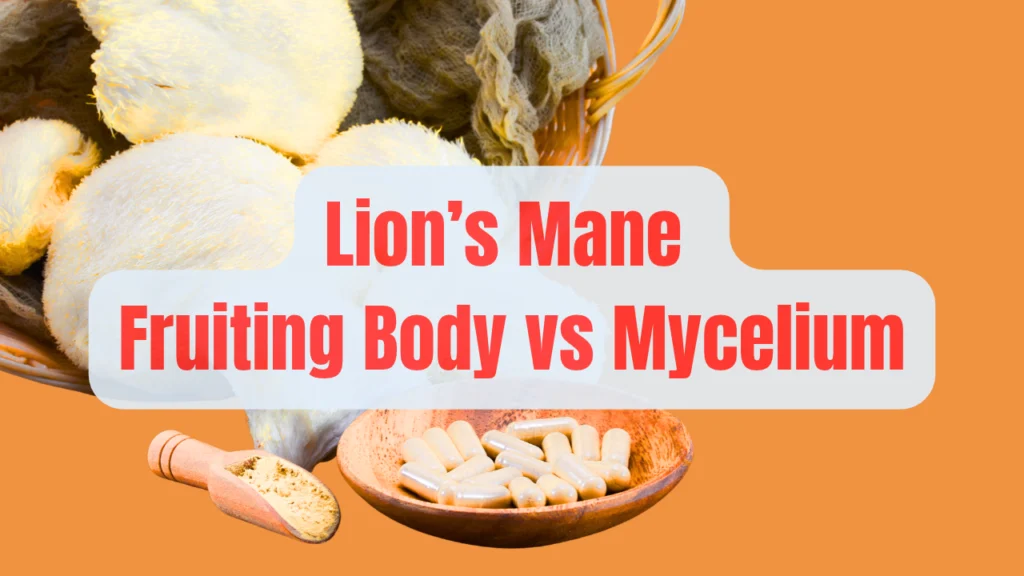
Fruiting body
The visible mushroom structure that people recognize as Lion’s Mane.
and:
Mycelium
The network of fungal filaments from which the fruiting body develops.
These aren’t interchangeable ingredients. Lion’s Mane Fruiting Body vs Mycelium
The fruiting body contains characteristic compounds such as hericenones, while the mycelium is particularly associated with erinacines. Both can also contain polysaccharides such as beta-glucans, although their overall chemical profiles differ. Reviews of H. erinaceus chemistry consistently distinguish hericenones from fruiting bodies and erinacines predominantly from mycelial material.
More importantly, both forms have appeared in human clinical research.
A classic 16-week cognitive trial used dried Lion’s Mane mushroom powder.
Another randomized trial used Lion’s Mane fruiting body for 12 weeks.
But a 49-week placebo-controlled study in people with mild Alzheimer’s disease used erinacine A-enriched Lion’s Mane mycelium.
So the evidence does not support the claim that:
“Fruiting body is scientifically proven and mycelium is useless.”
Nor does it support:
“Mycelium is automatically more powerful because it contains erinacines.”
The more accurate conclusion is:
Fruiting body and mycelium are chemically different Lion’s Mane materials with different research histories. Fruiting body has more straightforward precedent in several cognition studies and is easier to evaluate using beta-glucan and extraction information. Properly characterized mycelium can also be scientifically relevant—particularly when it is fermented under controlled conditions and standardized to erinacines. The real problem is not mycelium itself, but poorly characterized products where fungal biomass, grain substrate, extraction, and active-compound content are unclear.
That distinction can completely change how you shop for Lion’s Mane.
Important: Lion’s Mane research in humans remains preliminary. The 2025 systematic review found only five randomized controlled trials among the clinical literature and emphasized substantial variation in formulations and study designs. Lion’s Mane supplements should not replace medical assessment or treatment for cognitive impairment or neurological disease. Lion’s Mane Fruiting Body vs Mycelium
Recommended Articles 👇
👉 The Hidden Vitamin and Mineral Gaps That Might Be Blocking Your Weight Loss
👉 You Have This Resistance; That’s Why You’re Not Losing Weight.
Fruiting Body vs Mycelium at a Glance
| Feature | Fruiting Body | Mycelium |
|---|---|---|
| What is it? | Visible mushroom structure | Vegetative fungal network |
| Characteristic compounds | Hericenones | Erinacines |
| Beta-glucans | Present | Present |
| Human cognition research? | Yes | Yes |
| MCI research | Yes | Limited |
| Alzheimer’s pilot research | Not the key preparation | Erinacine A-enriched mycelium studied |
| Common supplement concern | Extraction and standardization | Grain/substrate dilution and poor characterization |
| Automatically better? | No | No |
| What matters most? | Species, extract, beta-glucans, testing | Species, substrate, erinacine standardization, testing |
First: What Is the Lion’s Mane Fruiting Body?
The fruiting body is the part most people picture when they hear:
Lion’s Mane mushroom.
It is the white, shaggy structure that grows from wood and produces spores.
This is also the culinary part of the mushroom.
The fruiting body contains:
- beta-glucans,
- phenolic compounds,
- sterols,
- terpenoid-related compounds,
- hericerins,
- hericenones,
- and numerous other metabolites.
A USDA-authored review of Hericium erinaceus chemistry describes a broad range of compounds across both fruiting bodies and mycelia, emphasizing that Lion’s Mane is not simply a delivery system for one single molecule.
That matters because supplement marketing often reduces the discussion to:
“Hericenones = fruiting body.”
That is only part of the picture. Lion’s Mane Fruiting Body vs Mycelium
What Are Hericenones?
Hericenones are a family of compounds isolated primarily from the fruiting body of Hericium erinaceus.
Researchers have now identified numerous hericenones, and recent chemical reviews continue to investigate their:
- neuroprotective,
- neurotrophic,
- anti-inflammatory,
- antioxidant,
- and other biological properties.
Historically, hericenones attracted attention because some laboratory studies suggested they could influence nerve-growth-factor-related pathways.
But this mechanism should not be oversold. Lion’s Mane Fruiting Body vs Mycelium
A review focused on Lion’s Mane neurobiology noted that some hericenones failed to increase NGF gene expression in particular cell models, while erinacine A showed more convincing preclinical central-nervous-system activity.
So statements such as:
“Fruiting body boosts NGF because it contains hericenones.”
are more certain than the human evidence permits.
What Is Lion’s Mane Mycelium?
Mycelium is the network of microscopic thread-like structures—called hyphae—that forms the vegetative body of the fungus.
It is not fake mushroom material.
Without mycelium, there is no fruiting body. Lion’s Mane Fruiting Body vs Mycelium
In nature, the mycelium grows through wood or other organic material and eventually produces a fruiting body when environmental conditions are appropriate.
The chemistry of the mycelium differs from the fruiting body.
Most importantly for the Lion’s Mane discussion:
erinacines are predominantly produced in mycelium.
What Are Erinacines?
Erinacines are cyathane diterpenoid compounds produced particularly by Lion’s Mane mycelium.
At least 20-plus erinacines have been identified, and the field continues to characterize new compounds and their biological activity.
A 2026 review describes erinacines as predominantly biosynthesized in Hericium mycelia and summarizes substantial preclinical interest in their:
- neurotrophic,
- neurogenic,
- anti-inflammatory,
- and neuroprotective properties.
Among them:
erinacine A
has received especially significant attention. Lion’s Mane Fruiting Body vs Mycelium
And unlike many supplement ingredients that are discussed only from animal studies, erinacine A-enriched mycelium has actually been used in a human clinical trial.
The Human Evidence: Fruiting Body
Let’s look at what was actually tested.
The 2009 Mild Cognitive Impairment Trial
One of the most frequently cited Lion’s Mane studies enrolled:
30 Japanese adults
aged:
50–80
with mild cognitive impairment. Lion’s Mane Fruiting Body vs Mycelium
Participants were randomized to Lion’s Mane or placebo.
The Lion’s Mane group took:
four 250 mg tablets
three times daily.
Each tablet contained:
96% dried Lion’s Mane powder.
That produced approximately:
3 grams per day
of the preparation.
The intervention lasted:
16 weeks.
At weeks:
8
12
and:
16
the Lion’s Mane group had significantly higher cognitive-function scores than placebo.
After supplementation stopped, scores declined during the following four-week observation period.
This is one of the stronger reasons fruiting-body-type preparations are frequently discussed for cognition.
But there are several limitations. Lion’s Mane Fruiting Body vs Mycelium
The trial had only:
15 people per group.
It was conducted in people already experiencing mild cognitive impairment.
And it did not establish that every modern commercial fruiting-body extract will reproduce those results.
The 2019 Fruiting Body Trial
Another randomized, double-blind, placebo-controlled study investigated supplements containing the:
fruiting body of Hericium erinaceus
for:
12 weeks.
Researchers used several cognitive assessments.
Only the MMSE showed a statistically significant improvement relative to placebo; other cognitive tests did not produce the same clear result.
That’s worth emphasizing.
The study did not show that Lion’s Mane enhanced every area of cognition.
This is much more realistic than the broad marketing promise:
“Lion’s Mane improves memory, focus, learning, attention and IQ.”
The human evidence isn’t strong enough for that statement. Lion’s Mane Fruiting Body vs Mycelium
What About Fruiting Body in Healthy Young Adults?
This is where the results become less impressive.
A more recent randomized crossover study tested an acute:
3 g dose of a 10:1 fruiting-body extract
in:
18 healthy adults aged 18–35.
Researchers evaluated cognition and mood approximately:
90 minutes after ingestion.
The result?
There was no statistically significant overall improvement in global cognitive performance or mood.
One individual motor-dexterity test improved, but the researchers concluded that any acute effects appeared task-specific rather than broadly cognitive-enhancing.
This is very important for buyers. Lion’s Mane Fruiting Body vs Mycelium
Fruiting body has legitimate clinical evidence.
But it is not:
a proven instant nootropic for healthy people.
The Human Evidence: Mycelium
Now we get to the part that makes the “fruiting body only” argument difficult to defend.
Erinacine A-Enriched Mycelium and Mild Alzheimer’s Disease
A placebo-controlled pilot study enrolled people with:
mild Alzheimer’s disease.
The intervention consisted specifically of:
Hericium erinaceus mycelia enriched with erinacine A.
Each capsule contained:
350 mg mycelium
standardized to:
5 mg/g erinacine A.
Participants took:
three capsules daily
for:
49 weeks.
That works out to:
1,050 mg mycelial material per day
and approximately:
5.25 mg erinacine A per day.
The study found differences favoring the erinacine-enriched mycelium group across several cognitive and functional outcomes.
The intervention group improved on MMSE, and differences were also found in activities-of-daily-living outcomes and certain neuroimaging or biomarker measurements. Lion’s Mane Fruiting Body vs Mycelium
Four participants discontinued because of:
- abdominal discomfort,
- nausea,
- or skin rash.
Otherwise, no major safety signal was reported.
This Mycelium Was Not Simply “Grain Powder”
This detail is crucial.
The mycelium used in this trial was cultured under controlled fermentation conditions.
Researchers describe producing the mycelium in a:
submerged liquid medium
containing glucose, yeast extract, soybean powder, peptone, and minerals. Lion’s Mane Fruiting Body vs Mycelium
The material was grown in fermentation tanks, lyophilized, and analytically standardized to erinacine A before being encapsulated.
That is very different from a poorly characterized supplement consisting of:
myceliated grain ground directly into powder.
This is why saying:
“Clinical studies show mycelium works, so any mycelium product is good.”
is just as misleading as saying:
“Mycelium is useless.”
The clinical evidence applies most directly to the specific standardized mycelium preparation that was tested.
Fruiting Body vs Mycelium: Which Has Better Human Evidence?
There isn’t a simple winner. Lion’s Mane Fruiting Body vs Mycelium
Fruiting body has direct human evidence for:
- mild cognitive impairment,
- certain cognitive outcomes in older adults,
- and acute cognition testing in healthy younger adults.
Mycelium has direct human evidence for:
- erinacine A-standardized supplementation in mild Alzheimer’s disease.
A 2025 systematic review of Lion’s Mane supplements found only:
five randomized controlled trials
within the clinical literature it evaluated, alongside pilot trials and substantial laboratory research.
That is not enough evidence to declare:
fruiting body clinically superior to mycelium
or:
mycelium clinically superior to fruiting body.
We would ideally need a trial directly comparing:
matched fruiting-body extract
versus:
matched standardized mycelium
versus:
placebo
under the same conditions. Lion’s Mane Fruiting Body vs Mycelium
That evidence does not currently exist at the level needed to settle the debate.
Why Fruiting Body Products Dominate the Supplement Market
There are several practical reasons.
1. Fruiting body is easy for consumers to understand
It is literally the mushroom.
That makes:
100% fruiting body
an easy marketing message. Lion’s Mane Fruiting Body vs Mycelium
2. Fruiting body products can disclose beta-glucans
Beta-glucans are structural polysaccharides in fungal cell walls and can be quantified.
This gives consumers at least one measurable quality marker.
3. Fruiting body avoids the grain-substrate controversy
If the ingredient is clearly:
100% fruiting body extract
there is less concern that the capsule is substantially composed of residual cereal substrate.
4. Several human studies used fruiting-body preparations
That provides a legitimate evidence foundation. Lion’s Mane Fruiting Body vs Mycelium
But none of these points proves that the fruiting body contains every biologically interesting Lion’s Mane compound.
The Big Problem: “Mycelium” Can Mean Very Different Things
This is perhaps the most important part of the article.
When a label says:
mycelium
you need to ask:
Mycelium grown how?
There are at least two very different possibilities.
Liquid-Cultured / Submerged Mycelium
Mycelium can be grown in liquid fermentation. Lion’s Mane Fruiting Body vs Mycelium
This allows the fungal biomass to be separated and controlled more precisely.
The erinacine-A Alzheimer’s trial used this type of controlled fermentation process.
This is a legitimate mycelial ingredient.
Mycelium Grown on Grain Lion’s Mane Fruiting Body vs Mycelium
Another common commercial method involves growing fungal mycelium on:
- rice,
- oats,
- sorghum,
- millet,
- or another grain substrate.
The mycelium colonizes that grain. Lion’s Mane Fruiting Body vs Mycelium
Depending on processing, the entire material can then be dried and powdered.
That means the final ingredient may contain:
fungal mycelium + residual grain.
That doesn’t automatically make it unsafe or fraudulent. Lion’s Mane Fruiting Body vs Mycelium
But it is not chemically equivalent to purified mycelial biomass.
Why Alpha-Glucans Matter
This is where glucan testing becomes useful. Lion’s Mane Fruiting Body vs Mycelium
Fungal materials naturally contain beta-glucans.
Grain contains substantial starch, which contributes to:
alpha-glucan measurements.
Analytical methods for mushroom products therefore measure:
- total glucans,
- alpha-glucans,
- and beta-glucans
separately.
A validated AOAC analytical method specifically measures alpha-glucans—including starch and glycogen—then calculates beta-glucan by difference.
That makes alpha-glucan especially useful when evaluating products where significant grain substrate may remain.
High beta-glucans
generally indicate substantial fungal cell-wall material.
High alpha-glucans
may indicate more:
- starch,
- glycogen,
- or grain-derived carbohydrate.
But even this needs nuance.
You should not say:
“Any alpha-glucans mean the product is fake.”
Fungi can naturally contain alpha-linked carbohydrates too.
The issue is proportion and context. Lion’s Mane Fruiting Body vs Mycelium
Fruiting Body Does Not Automatically Mean High Quality Either
The supplement industry sometimes turns the fruiting-body argument into:
“If it says fruiting body, it must be good.”
That’s also wrong. Lion’s Mane Fruiting Body vs Mycelium
A fruiting-body supplement can still be:
- underdosed,
- poorly extracted,
- inaccurately labeled,
- contaminated,
- low in beta-glucans,
- or produced from poor raw material.
The label:
100% fruiting body
answers only one question:
What fungal structure was used?
It does not answer:
How good is the product? Lion’s Mane Fruiting Body vs Mycelium
Are Beta-Glucans Higher in Fruiting Body?
Not always.
Both mycelium and fruiting body contain fungal cell-wall polysaccharides.
The quantity depends on:
- strain,
- cultivation,
- growth substrate,
- extraction,
- harvest stage,
- and analytical method.
Research confirms measurable beta-glucans in Lion’s Mane material, but the exact percentage varies significantly between preparations.
This is why Article #2 in this cluster will examine:
beta-glucans, hericenones, and erinacines
in much greater detail. Lion’s Mane Fruiting Body vs Mycelium
Which Has More Hericenones?
Fruiting body.
Modern chemical analyses consistently associate hericenones primarily with the fruiting body.
A 2025 chemistry paper reviewing their original isolation notes that:
hericenones C–H were identified from Lion’s Mane fruiting bodies, while erinacines were identified from mycelia.
So if you specifically want a fruiting-body chemical profile:
hericenone-containing material is relevant. Lion’s Mane Fruiting Body vs Mycelium
But there is currently no standardized consumer rule such as:
“A good Lion’s Mane supplement must contain X mg of hericenone C.”
Most commercial products do not quantify individual hericenones.
And human dose-response data are insufficient to establish such a target.
Which Has More Erinacines?
Mycelium.
A 2026 review describes erinacines as being predominantly biosynthesized in Lion’s Mane mycelium.
This is particularly relevant for:
erinacine A.
But again:
not every mycelium product is erinacine-rich. Lion’s Mane Fruiting Body vs Mycelium
The Alzheimer’s trial specifically used mycelium standardized to:
5 mg/g erinacine A.
A generic label saying:
Lion’s Mane mycelium — 500 mg
does not tell you whether the product contains a clinically meaningful amount of erinacine A.
That is a huge difference.
Which One Is Better for Nerve Growth Factor?
We don’t know clinically. Lion’s Mane Fruiting Body vs Mycelium
This is one of the most exaggerated claims in the Lion’s Mane industry.
Preclinical research suggests several Lion’s Mane compounds influence:
- NGF,
- BDNF,
- neurite growth,
- and neurotrophic signaling.
Current mechanistic reviews generally emphasize:
erinacines from mycelium
and:
hericenones from fruiting body
as potentially neuroactive classes. Lion’s Mane Fruiting Body vs Mycelium
But most of this evidence comes from:
- cells,
- rodents,
- molecular experiments,
- and mechanistic studies.
We do not have a robust human trial showing:
“Fruiting body increases human brain NGF by X%.”
Nor:
“Mycelium raises NGF more than fruiting body in humans.”
So if a supplement company advertises:
clinically proven NGF enhancement
based mainly on preclinical research, treat that claim cautiously. Lion’s Mane Fruiting Body vs Mycelium
What About Products Containing Both Fruiting Body and Mycelium?
These can be legitimate. Lion’s Mane Fruiting Body vs Mycelium
A human mood/sleep study used a supplement containing:
80% mycelium
and:
20% fruiting-body extract
for eight weeks.
A very recent 2026 pilot study in healthy adults used:
2 g/day
of a certified organic supplement containing both:
mycelial biomass + fruiting body
for 28 days. Lion’s Mane Fruiting Body vs Mycelium
That small uncontrolled study found no statistically significant improvement in executive function or plasma BDNF, although modest effect sizes were reported.
This reinforces an important point:
“Contains both” does not automatically mean better.
A blended product should disclose:
- how much of each form it contains,
- whether the mycelium includes substrate,
- what compounds are standardized,
- and how the final product is tested.
Fruiting Body vs Mycelium vs Myceliated Grain
These three terms should never be treated as synonyms.
| Ingredient | What It Actually Means |
|---|---|
| Fruiting body | Mature mushroom structure |
| Mycelium | Fungal vegetative biomass |
| Myceliated grain | Grain substrate colonized by mycelium |
| Erinacine-enriched mycelium | Controlled mycelial preparation standardized to erinacines |
| Fruiting-body extract | Fruiting-body material processed to concentrate extractable compounds |
The quality discussion becomes much more useful once these are separated. Lion’s Mane Fruiting Body vs Mycelium
Is Fruiting Body Better for General Consumers?
For many shoppers:
yes, as a practical default—not because it is clinically proven superior.
Why?
Because a high-quality fruiting-body extract is often easier to evaluate.
You can look for:
- Hericium erinaceus,
- 100% fruiting body,
- beta-glucan content,
- extraction method,
- heavy-metal testing,
- microbial testing,
- and batch-specific quality documentation.
It creates a relatively transparent purchasing framework. Lion’s Mane Fruiting Body vs Mycelium
That is one reason fruiting-body products rank highly in our Best Lion’s Mane Supplements guide.
But if a mycelium product is:
- genuinely isolated fungal biomass,
- carefully fermented,
- standardized to erinacines,
- independently tested,
- and backed by formulation-specific research,
I would not reject it simply because it says:
mycelium.
When Would I Specifically Choose Mycelium?
I would be more interested in mycelium when the product does something most generic mycelium products do not:
quantifies erinacines.
For example:
Hericium erinaceus mycelium
Erinacine A: X mg/g
Fermented in liquid culture
Independently tested
That gives you something meaningful to compare with erinacine-focused clinical research.
Without that information:
“500 mg Lion’s Mane mycelium”
is much harder to evaluate. Lion’s Mane Fruiting Body vs Mycelium
When Would I Choose Fruiting Body?
A fruiting-body extract is particularly attractive when the label provides:
Species
Hericium erinaceus
Mushroom material
100% fruiting body
Extraction
For example:
hot-water extract
or:
dual extract
Beta-glucans
A measured percentage rather than vague:
“polysaccharides.”
Testing
Independent testing for:
- identity,
- beta-glucans,
- heavy metals,
- microbes,
- and other contaminants.
This doesn’t guarantee cognitive benefits. Lion’s Mane Fruiting Body vs Mycelium
But it gives you considerably more confidence that you understand what you’re buying.
Does Extraction Matter More Than Fruiting Body vs Mycelium?
Sometimes it may. Lion’s Mane Fruiting Body vs Mycelium
Different Lion’s Mane compounds have different chemical properties.
Water extraction emphasizes certain water-soluble components, particularly polysaccharides.
Alcohol-based extraction can recover a different spectrum of less-polar compounds.
A recent fruiting-body cognition study specifically used both:
aqueous and ethanolic extraction
to produce a concentrated 10:1 fruiting-body extract.
Research on fruiting bodies also shows that extraction methodology can substantially change measured bioactive composition.
So:
fruiting body vs mycelium
is only one layer. Lion’s Mane Fruiting Body vs Mycelium
The fuller question is:
Which fungal material + which extraction process + which measured compounds + which human evidence?
Does a 10:1 Fruiting Body Extract Beat Raw Mycelium?
Not automatically.
A:
10:1 extract
means more starting material was used relative to the amount of final extract.
It does not mean:
10 times more effective.
The extraction process can:
- concentrate some compounds,
- leave others behind,
- alter the chemical profile,
- and change bioavailability.
Likewise:
1,000 mg raw mushroom
and:
1,000 mg concentrated extract
should not be treated as equivalent doses. Lion’s Mane Fruiting Body vs Mycelium
This is why our upcoming Lion’s Mane Dosage article will compare powders and extracts separately.
My Practical Buying Hierarchy
If I were evaluating a Lion’s Mane product today, I would use this order. Lion’s Mane Fruiting Body vs Mycelium
1. Confirm the species
Look for:
Hericium erinaceus.
2. Identify the fungal material
The label should say:
- fruiting body,
- mycelium,
- both,
- or myceliated grain.
If it doesn’t:
that’s a transparency problem.
3. If fruiting body: check beta-glucans
Prefer a measured beta-glucan value rather than vague:
“polysaccharides.”
4. If mycelium: ask what it was grown on
Was it:
submerged liquid fermentation
or:
grain substrate?
5. If mycelium: look for erinacine standardization
Especially if the product uses erinacine research to justify cognitive claims.
6. Check extraction
Water?
Alcohol?
Dual extract?
Raw powder?
These are not chemically identical preparations. Lion’s Mane Fruiting Body vs Mycelium
7. Look for independent testing
Particularly:
- identity,
- beta-glucans,
- alpha-glucans/starch where relevant,
- heavy metals,
- and microbes.
8. Compare the product with the actual clinical evidence
Don’t let a generic ingredient borrow evidence from a completely different formulation.
Frequently Asked Questions
Is Lion’s Mane fruiting body better than mycelium?
Not conclusively.
Fruiting body and mycelium contain different compounds and both have human clinical evidence.
There is no strong direct human trial proving one is universally superior.
Which is better for cognition?
Fruiting-body preparations have direct randomized human evidence in mild cognitive impairment and older adults.
Erinacine A-enriched mycelium also has human evidence from a long-term pilot study in mild Alzheimer’s disease.
The evidence is insufficient to name a universal winner.
Is Lion’s Mane mycelium useless?
No.
That claim is contradicted by human research using erinacine A-enriched H. erinaceus mycelium.
The important distinction is between:
well-characterized mycelium
and:
poorly characterized myceliated grain products.
Is mycelium grown on grain bad?
Not automatically.
Mycelium can legitimately be cultivated on grain.
The issue is whether substantial residual grain ends up in the final supplement and whether the label clearly explains that.
High starch/alpha-glucan content can help indicate substrate contribution.
Does fruiting body contain erinacines?
Erinacines are predominantly associated with mycelium.
Fruiting bodies are more strongly associated with hericenones.
DOES mycelium contain hericenones?
The characteristic hericenones studied in Lion’s Mane are primarily associated with fruiting bodies.
Different fungal tissues have different secondary-metabolite profiles.
Which form has more beta-glucans?
There is no universal answer.
Beta-glucan concentration varies with:
strain,
cultivation,
fungal material,
substrate,
extraction,
and analytical method.
Both fruiting body and mycelium contain fungal beta-glucans.
Why do people avoid Lion’s Mane mycelium?
The main concern is often not mycelium itself.
It is:
mycelium grown on grain where the final powder may contain substantial residual grain.
That can dilute the fungal material relative to a purified mycelial biomass or 100% fruiting-body product.
Is fruiting body better because it has no grain?
A genuine 100% fruiting-body product avoids the specific issue of residual mycelial growth substrate.
That is a useful quality advantage.
It does not establish greater clinical effectiveness.
What is erinacine A?
Erinacine A is a cyathane diterpenoid produced primarily by Lion’s Mane mycelium.
It has extensive preclinical neurotrophic research and has also been standardized in a 49-week human trial using erinacine A-enriched mycelia.
What are hericenones?
Hericenones are a family of secondary metabolites primarily isolated from Lion’s Mane fruiting bodies.
They have been investigated for several biological properties, including neurotrophic and neuroprotective mechanisms, but the strongest mechanistic evidence remains preclinical.
Should I buy a product containing both fruiting body and mycelium?
Potentially.
But “both” does not automatically mean superior.
Look for:
exact proportions,
cultivation method,
beta-glucans,
erinacines if claimed,
substrate disclosure,
extraction,
and independent testing.
Is a fruiting-body extract better than whole mushroom powder?
Not automatically.
Extracts can concentrate selected compounds, while whole mushroom powder retains a broader range of material.
The relevant question is which preparation resembles the research and provides meaningful quality information.
The Bottom Line
So which is better:
Lion’s Mane fruiting body
or:
Lion’s Mane mycelium?
The evidence does not support a universal winner.
Fruiting body
has several advantages. Lion’s Mane Fruiting Body vs Mycelium
It is:
- easy to identify,
- supported by human cognition trials,
- straightforward to standardize for beta-glucans,
- and avoids the specific problem of residual grain from myceliated-grain production.
A 16-week randomized trial using approximately:
3 g/day dried Lion’s Mane
found significantly better cognitive scores than placebo at weeks 8, 12, and 16 in people with mild cognitive impairment.
Another randomized trial using fruiting body for 12 weeks also found improvement in one cognitive measure, although not across all tests.
But:
mycelium is not scientifically inferior by definition.
A 49-week placebo-controlled study used:
erinacine A-enriched Lion’s Mane mycelium
and reported favorable differences in several cognitive and functional outcomes among people with mild Alzheimer’s disease.
Importantly, that mycelium was:
- produced through controlled fermentation,
- analytically standardized,
- and specifically enriched in erinacine A.
It was not simply an unidentified myceliated grain powder. Lion’s Mane Fruiting Body vs Mycelium
So the buying rule I would use is:
Don’t ask only “fruiting body or mycelium?”
Ask:
1. Is it actually Hericium erinaceus?
2. Which fungal material is being used?
3. If mycelium, what was it grown on?
4. Are beta-glucans measured?
5. Are erinacines quantified if mycelium-related neurotrophic claims are being made?
6. What extraction method was used?
7. Is the finished product independently tested?
8. Does the formulation actually resemble the clinical evidence being cited?
For most general supplement shoppers, I still consider a:
transparent, well-tested fruiting-body extract with disclosed beta-glucans
the simplest starting point.
That is a quality-control preference, not proof that fruiting body is biologically superior.
If a mycelium product provides:
- controlled cultivation,
- minimal substrate contamination,
- quantified erinacines,
- and strong analytical testing,
it deserves to be evaluated on its own merits.
And that is the key takeaway:
Fruiting body vs mycelium is not a good-vs-bad debate.
It is a question of:
different fungal tissues, different compounds, different formulations, and different evidence.
If you’re ready to compare finished products based on fruiting body/mycelium source, beta-glucans, extract type, dosage, testing, and value, see our Best Lion’s Mane Supplements guide. Lion’s Mane Fruiting Body vs Mycelium
- PubMed — 2025 Lion’s Mane Systematic Review
- PubMed — Mild Cognitive Impairment Trial
- PubMed — Fruiting Body Cognitive Trial
- PubMed — Erinacine A Mycelium Alzheimer’s Trial
- PubMed — 2026 Erinacine Review
- PubMed — 2026 Hericenone Review
- PubMed — Lion’s Mane Chemistry Review
- PubMed — Acute Fruiting Body Cognitive Trial
- PubMed — Mushroom Beta-Glucan Analytical Method
- PubMed — Hericenones and Erinacines Chemistry
- PubMed — 2026 Healthy Adult Lion’s Mane Pilot

Ali Webster is a seasoned researcher, communicator, and Registered Dietitian with a diverse background encompassing government, nonprofits, academia, and health care. The core belief is that science should be made accessible, understandable, and relevant to all individuals, driving the motivation behind their work. Proficient in conducting and interpreting research to shape nutrition policy decisions, the individual also excels in nutrition and health communication, consumer research survey development and implementation, and clinical nutrition. Holding a Doctorate of Philosophy with a focus on Nutrition and Epidemiology from the University of Minnesota, their dietetic internship emphasized medical nutrition therapy.