► Table of Contents
- Beetroot vs Citrulline: What’s the Difference?
- Why Does Nitric Oxide Matter During Exercise?
- What Does the Latest Nitrate Research Show?
- Does Beetroot Improve Endurance?
- Does Beetroot Improve Strength?
- What About Squats and Bench Press?
- What About Muscle Power?
- How Much Nitrate Actually Works?
- Why Standardized Nitrate Matters
- How Much Nitrate Is Actually in Pre Lab Pro?
- Does More Beetroot Automatically Mean More Nitrate?
- What About Citrulline?
- Does Citrulline Improve Endurance?
- What About Citrulline for Resistance Training?
- What Does the Newer Citrulline Evidence Say?
- Why Add Glutathione to Citrulline?
- What Has Setria Performance Blend Actually Been Shown to Do?
- What Did That Study Find?
- Does Setria Help Build Muscle?
- Is Beetroot + Citrulline Better Than Either Alone?
- Can Beetroot and Citrulline Give You a Better Pump?
- Why Timing Matters More for Beetroot Than Many Labels Suggest
- Why Mouthwash Can Matter for Beetroot
- Who Responds Best to Dietary Nitrate?
- Does Nitrate Work for Women?
- How Does Pre Lab Pro’s Nitric-Oxide Formula Compare With the Research?
- Could Citrulline Compensate for the Lower Beetroot Nitrate?
- Does Pre Lab Pro Produce a “2X Nitric Oxide Surge”?
- Is Pre Lab Pro Underdosed for Nitric Oxide?
- Who Might Still Find This Formula Attractive?
- Frequently Asked Questions
- Does beetroot improve workout performance?
- How much nitrate should beetroot provide?
- Is beetroot powder the same as nitrate?
- Does citrulline improve workouts?
- How much citrulline is normally used?
- What is Setria Performance Blend?
- Does Setria Performance Blend improve endurance?
- Does nitric oxide give you a bigger pump?
- How much nitrate is in Pre Lab Pro?
- 22.5–41.25 mg nitrate per scoop.
- Does that mean Pre Lab Pro’s beetroot does nothing?
- Should beetroot be taken 30 minutes before exercise?
- Can beetroot and citrulline be taken together?
- The Bottom Line
Some pre-workouts try to overwhelm you with stimulants.
Others take a different approach:
increase nitric oxide.
The idea sounds appealing.
More nitric oxide may relax blood vessels.
Relaxed blood vessels may increase blood flow.
More blood flow may mean improved delivery of oxygen and nutrients to working muscles.
And that could potentially mean:
better endurance,
greater muscular efficiency,
more repetitions,
higher power,
and a stronger gym “pump.”
Two of the most popular ingredients used for this purpose are:
beetroot
and
L-citrulline.
They both influence nitric-oxide biology—but through different pathways.
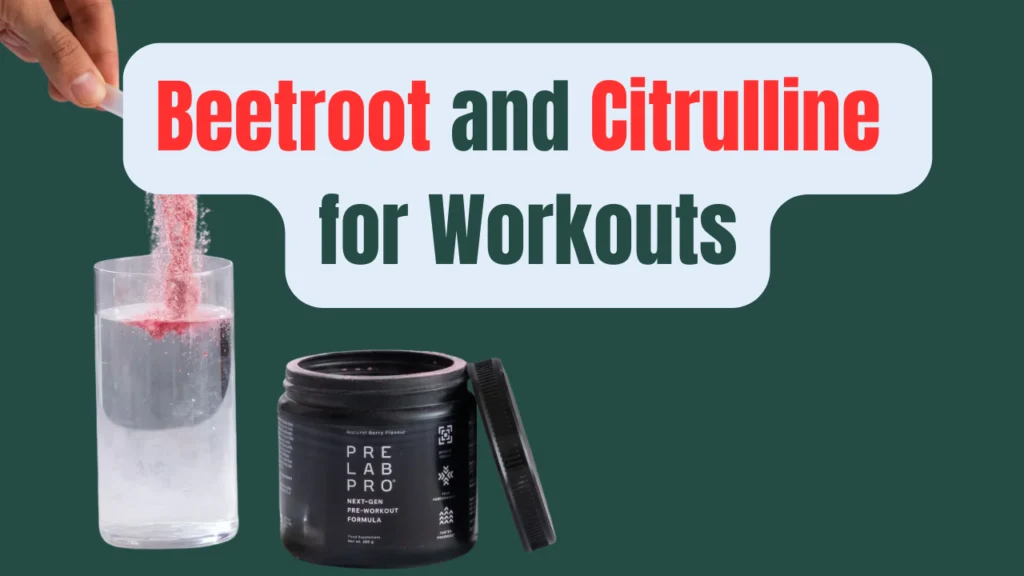
And that difference matters. Beetroot and Citrulline
Dietary nitrate from beetroot has relatively strong evidence for selected endurance, muscular-endurance, and power outcomes, particularly when enough nitrate is consumed. Citrulline can increase circulating arginine and nitric-oxide-related markers, but exercise-performance findings are considerably more mixed. Combining the two is scientifically plausible, but current evidence does not prove that beetroot + citrulline automatically produces a stronger workout effect than either ingredient alone.
That becomes particularly relevant when evaluating products such as Pre Lab Pro, which combines:
1,500 mg standardized beetroot
with
2,200 mg Setria® Performance Blend containing L-citrulline + glutathione.
The ingredients make biological sense.
But the doses and research context deserve a closer look.
Important: This article is educational and is not medical advice. Nitric-oxide-support supplements can affect blood pressure and circulation, and people taking medications or managing cardiovascular conditions should seek appropriate professional advice before using them.
Recommended Articles 👇
👉 The Hidden Vitamin and Mineral Gaps That Might Be Blocking Your Weight Loss
👉 You Have This Resistance; That’s Why You’re Not Losing Weight.
Beetroot vs Citrulline: What’s the Difference?
Both ingredients can ultimately influence nitric oxide.
But they get there through different pathways.
Beetroot
Beetroot contains dietary nitrate.
The body converts:
nitrate → nitrite → nitric oxide
through what is known as the nitrate–nitrite–nitric oxide pathway.
This pathway is particularly interesting during exercise because conversion to nitric oxide can become more active under lower-oxygen and acidic conditions—exactly the type of environment that develops in hard-working muscle.
Citrulline
L-citrulline works through another route.
The body converts citrulline into:
L-arginine
and arginine can then be used by nitric-oxide synthase enzymes to create:
nitric oxide.
So in simplified terms:
Beetroot supplies nitrate.
Citrulline increases arginine availability.
Both may raise nitric-oxide signaling, but they are not interchangeable. Beetroot and Citrulline
Why Does Nitric Oxide Matter During Exercise?
Nitric oxide performs several functions relevant to sport.
It contributes to:
- blood-vessel dilation,
- blood-flow regulation,
- skeletal-muscle contractile function,
- mitochondrial efficiency,
- glucose handling,
- and oxygen utilization.
That sounds like a recipe for dramatically better performance.
But biological plausibility does not guarantee large real-world improvements.
The critical question is:
Do controlled human trials actually show better performance?
For dietary nitrate, the answer is:
sometimes, yes.
For citrulline:
sometimes—but much less consistently. Beetroot and Citrulline
What Does the Latest Nitrate Research Show?
One of the strongest current summaries is a 2025 umbrella review that examined 20 systematic reviews and meta-analyses.
Collectively, those reviews represented:
180 primary studies
and
2,672 participants.
Researchers found that nitrate supplementation significantly improved several outcomes, including:
- time to exhaustion,
- total distance covered,
- muscular endurance,
- peak power,
- and time to peak power.
But several other performance outcomes did not significantly improve.
That distinction matters.
Nitrate appears genuinely ergogenic.
But it is not a guaranteed performance enhancer for every exercise test. Beetroot and Citrulline
Does Beetroot Improve Endurance?
This is probably the most established application.
A systematic review and meta-analysis of 73 endurance studies involving more than 1,000 participants found nitrate supplementation improved:
- power output,
- time to exhaustion,
- and distance traveled.
However, there was no significant improvement in every outcome, including some time-trial measures.
This suggests nitrate may be particularly useful for increasing exercise capacity—how long someone can continue before exhaustion—rather than guaranteeing faster performance in every race format.
That difference is important. Beetroot and Citrulline
A supplement can improve a laboratory time-to-exhaustion test without automatically producing an equivalent improvement in a real race.
Does Beetroot Improve Strength?
Potentially—but the effect appears relatively small.
A systematic review and meta-analysis examining muscular performance found nitrate supplementation had:
a trivial but statistically significant effect on muscular strength
and
a small but significant effect on muscular endurance.
So nitrate appears more compelling for:
performing repeated work
than for dramatically increasing one-repetition maximal strength.
That makes sense physiologically. Beetroot and Citrulline
Improved muscle efficiency and blood flow may be more relevant when fatigue builds across repeated contractions.
What About Squats and Bench Press?
A meta-analysis specifically examining resistance-trained men found nitrate supplementation improved:
- repetitions to failure,
- mean power,
- and mean velocity
when squat and bench-press studies were combined.
It did not significantly improve:
- peak power,
- or peak velocity.
Again, this is a good example of why the phrase:
“Beetroot improves strength”
is too broad. Beetroot and Citrulline
A more defensible statement is:
Nitrate may modestly improve muscular endurance and some power/velocity outcomes during resistance exercise, particularly under repeated effort.
What About Muscle Power?
There is stronger evidence here.
An individual-participant meta-analysis of 19 studies involving 268 participants found that dietary nitrate increased maximal muscle power by approximately:
5% on average.
The effect was present with both acute and repeated supplementation, although the acute effect appeared larger in that analysis.
That finding is practically interesting.
A 5% change is not trivial in competitive sport.
But averages do not guarantee every athlete will respond the same way. Beetroot and Citrulline
How Much Nitrate Actually Works?
This is where the discussion becomes especially important.
Beetroot powder is not the same thing as nitrate dose.
A product can contain several grams of beetroot while providing relatively little actual nitrate.
The 2025 umbrella review found that improvements in time-to-exhaustion were more pronounced when participants consumed at least:
6 mmol nitrate per day
which equals approximately:
372 mg nitrate
and when supplementation continued for more than three days.
Other reviews commonly describe effective nitrate strategies in the approximate range of:
5–16.8 mmol
or roughly:
300–1,041 mg nitrate
often consumed 2–3 hours before exercise.
This does not mean 372 mg is a magical threshold below which nitrate does nothing.
It means performance research is generally conducted using hundreds of milligrams of actual nitrate, not merely hundreds or thousands of milligrams of beetroot powder. Beetroot and Citrulline
Why Standardized Nitrate Matters
Imagine two supplements.
Product A
Contains:
2,000 mg generic beetroot powder
but does not disclose nitrate concentration.
Product B
Contains:
1,000 mg standardized beetroot
providing a known amount of nitrate.
You cannot assume Product A delivers more active nitrate simply because the beetroot weight is larger.
This is why nitrate standardization is more useful than beetroot milligrams alone.
Pre Lab Pro at least discloses that its beetroot is standardized to approximately:
1.5%–2.75% natural nitrate.
That lets us perform a meaningful comparison. Beetroot and Citrulline
How Much Nitrate Is Actually in Pre Lab Pro?
Pre Lab Pro contains:
1,500 mg beetroot powder
standardized to:
1.5%–2.75% nitrate.
If those percentages apply directly to the 1,500 mg ingredient amount, that works out to approximately:
22.5–41.25 mg nitrate per scoop.
In molar terms, that’s roughly:
0.36–0.67 mmol nitrate.
That is far below the approximately:
6 mmol / 372 mg
associated with stronger time-to-exhaustion effects in the 2025 umbrella review.
Even two scoops would provide an estimated:
45–82.5 mg nitrate
or approximately:
0.73–1.33 mmol.
Again:
that does not prove the beetroot dose is useless.
The formula also contains citrulline and glutathione.
And nitrate dose-response relationships vary by outcome.
But it does mean the statement:
“Pre Lab Pro provides a research-level beetroot nitrate dose”
would require much more caution. Beetroot and Citrulline
The actual nitrate amount appears considerably lower than the quantities used in much of the dedicated nitrate-performance literature.
Does More Beetroot Automatically Mean More Nitrate?
No.
This is why comparing beetroot supplements by grams alone can be misleading.
A concentrated standardized extract might provide more nitrate per gram than ordinary beetroot powder.
But ultimately the useful number is:
actual nitrate delivered.
If the nitrate amount is not disclosed, performance claims become much harder to evaluate.
Pre Lab Pro deserves credit for disclosing its standardization. Beetroot and Citrulline
That transparency is useful even when the comparison raises questions about dose.
What About Citrulline?
L-citrulline is another popular nitric-oxide supplement.
It has an advantage over oral arginine because citrulline generally raises blood arginine more efficiently.
That makes it biologically attractive.
But performance research is inconsistent. Beetroot and Citrulline
Does Citrulline Improve Endurance?
Not convincingly based on current evidence.
A systematic review and meta-analysis examining citrulline and aerobic exercise found no significant improvement in:
- aerobic performance,
- rating of perceived exertion,
- oxygen kinetics,
- or lactate.
Another meta-analysis focusing on endurance outcomes similarly found no significant improvement in:
- time to exhaustion,
- or time-trial completion
after acute citrulline supplementation. Beetroot and Citrulline
So pure citrulline currently has a weaker endurance-performance case than dietary nitrate.
What About Citrulline for Resistance Training?
The evidence becomes somewhat more positive.
A meta-analysis examining acute citrulline malate supplementation found that:
6–8 g taken 40–60 minutes before resistance exercise
increased repetitions to failure by roughly:
3 repetitions on average
or approximately:
6% compared with placebo.
That’s a small but potentially meaningful effect.
However, this research used citrulline malate.
Pre Lab Pro uses L-citrulline combined with glutathione.
Those are not the same intervention. Beetroot and Citrulline
You should not automatically transfer the 6–8 g citrulline-malate findings to a 2 g L-citrulline dose.
What Does the Newer Citrulline Evidence Say?
A 2026 systematic review and meta-analysis included:
30 randomized trials
and
644 participants.
It found a small overall improvement in exercise performance from citrulline malate.
But the authors rated the certainty of evidence as:
low to very low
and concluded that reliable optimal:
- doses,
- timing,
- and target populations
still have not been established.
That is probably the best way to characterize citrulline currently:
plausible and potentially useful—but not universally effective.
Why Add Glutathione to Citrulline?
This is the specific strategy behind Pre Lab Pro’s Setria® Performance Blend.
The proposed idea is:
Citrulline increases arginine availability.
Arginine helps support nitric-oxide production.
Glutathione may help protect nitric oxide from oxidative degradation.
In theory, that could create a stronger or longer-lasting nitric-oxide response.
A human study found that combining L-citrulline with glutathione increased markers associated with nitric-oxide synthesis more than placebo.
This is biologically interesting. Beetroot and Citrulline
But improving nitric-oxide biomarkers is not automatically the same thing as improving running, lifting, or cycling performance.
That distinction becomes very important when we examine the Setria Performance Blend directly.
What Has Setria Performance Blend Actually Been Shown to Do?
A 2023 randomized, double-blind, placebo-controlled crossover study tested the same named Setria Performance Blend.
Participants received:
2 g L-citrulline
plus
200 mg glutathione
for eight days.
That totals exactly:
2,200 mg
—the same total blend weight currently listed in Pre Lab Pro.
This is one of the strongest ingredient-dose matches in the formula. Beetroot and Citrulline
What Did That Study Find?
Twenty-five trained men completed treadmill exercise tests at:
- 90%,
- 100%,
- and 110%
of peak velocity.
Researchers also measured:
- blood flow,
- vessel diameter,
- plasma citrulline,
- and plasma arginine.
The Setria blend significantly increased:
post-exercise blood flow
and increased circulating:
citrulline and arginine.
That sounds positive.
But now comes the most important result:
time to exhaustion did not significantly improve at any of the three exercise intensities.
The authors’ own conclusion was explicit:
the blend did not enhance time-to-exhaustion performance in these trained men.
It did improve post-exercise blood flow, which could potentially have implications for recovery, but a direct endurance-performance benefit was not demonstrated.
This is exactly why biomarkers and performance should not be treated as interchangeable. Beetroot and Citrulline
Does Setria Help Build Muscle?
Another trial investigated L-citrulline + glutathione during eight weeks of resistance training.
Seventy-five resistance-trained men were assigned to:
- citrulline + glutathione,
- citrulline malate,
- or placebo.
The study reported favorable body-composition findings with the combined supplement, including lean-mass changes, and found no concerning changes in clinical safety markers.
That is interesting.
But it should not be interpreted as:
“Taking Setria right before one workout instantly builds muscle.”
This was a chronic resistance-training study.
Muscle growth occurs over time. Beetroot and Citrulline
And the training program itself is a major part of the intervention.
Is Beetroot + Citrulline Better Than Either Alone?
You would expect two nitric-oxide pathways to be better than one.
Scientifically, that is plausible.
But human evidence is not yet strong enough to conclude that the combination is reliably superior.
A systematic review examining beetroot combined with other nutritional supplements found mixed results.
Some co-supplementation studies produced positive outcomes.
Others failed to outperform beetroot or placebo conditions.
More recently, a study of elite rowers using nitrate plus citrulline found no evidence of improved energy metabolism after one week of co-supplementation.
So:
more nitric-oxide ingredients ≠ automatically more performance.
The amount, timing, population, and exercise test still matter. Beetroot and Citrulline
Can Beetroot and Citrulline Give You a Better Pump?
Possibly.
A “pump” is not a formal performance outcome, but increased muscle blood flow is physiologically consistent with higher nitric-oxide availability.
Citrulline can increase circulating arginine.
Nitrate can increase nitric-oxide availability.
Setria Performance Blend has demonstrated greater post-exercise blood flow in one controlled trial.
So the biological rationale for a pump effect is reasonable. Beetroot and Citrulline
But remember:
pump is not the same as performance.
You can experience a stronger pump without becoming:
- stronger,
- faster,
- or able to perform meaningfully more work.
And a product that improves performance does not necessarily create a dramatic subjective pump. Beetroot and Citrulline
Why Timing Matters More for Beetroot Than Many Labels Suggest
This is another important point when evaluating pre-workouts.
Pre Lab Pro currently recommends:
1 scoop 30 minutes before exercise.
That timing makes sense for some of its ingredients, particularly caffeine.
But dietary nitrate research frequently uses much longer pre-exercise timing.
Reviews commonly report nitrate being taken approximately:
2–3 hours before exercise.
This is because nitrate must move through the nitrate–nitrite pathway before peak effects occur.
So Pre Lab Pro’s 30-minute general timing recommendation may not align perfectly with the timing used in many dedicated nitrate trials.
That does not prove the formula cannot work at 30 minutes. Beetroot and Citrulline
It means:
the caffeine and other ingredients may be operating on a different clock from the beetroot nitrate.
We will examine that issue in detail in Article #5.
Why Mouthwash Can Matter for Beetroot
This sounds strange, but it is scientifically relevant.
Conversion of dietary nitrate to nitrite depends partly on bacteria in the mouth.
Strong antibacterial mouthwash can interfere with those bacteria.
Research reviews therefore often advise avoiding antibacterial mouthwash around nitrate supplementation when trying to maximize nitrate-related effects.
This is a good example of how nitrate supplementation is more biologically complicated than:
“drink beetroot and nitric oxide goes up.” Beetroot and Citrulline
Who Responds Best to Dietary Nitrate?
Research suggests response can vary according to training status.
Highly trained endurance athletes sometimes show smaller effects than recreationally trained individuals.
One major meta-analysis found little clear benefit in the subgroup of highly trained endurance athletes.
Possible reasons include:
- already optimized vascular function,
- naturally higher nitric-oxide availability,
- better mitochondrial efficiency,
- and less room for supplementation to improve performance.
That does not mean elite athletes never respond.
It means the average response may be smaller. Beetroot and Citrulline
Does Nitrate Work for Women?
Female-specific evidence has historically been limited.
A 2025 systematic review and meta-analysis found nitrate supplementation produced a statistically significant improvement in power among healthy women but did not significantly improve:
- strength,
- or sprint performance.
The certainty of evidence ranged from low to moderate. Beetroot and Citrulline
This is useful because sports-supplement research has traditionally involved disproportionately male participants.
How Does Pre Lab Pro’s Nitric-Oxide Formula Compare With the Research?
Here is the most useful summary.
| Ingredient | Pre Lab Pro | Research Context | Assessment |
|---|---|---|---|
| Beetroot powder | 1,500 mg | Actual nitrate dose matters more than beetroot weight | Standardized, but nitrate amount appears relatively low |
| Estimated nitrate | ~22.5–41.25 mg | Many studies use ~300–1,000+ mg nitrate | Considerably below typical dedicated nitrate research |
| Setria Performance Blend | 2,200 mg | Human trial used exactly 2 g citrulline + 200 mg glutathione | Strong dose/form match |
| L-citrulline within Setria study | 2 g | Citrulline-malate studies often use 6–8 g | Lower than many classic CitMal protocols, but different formulation |
| Glutathione | 200 mg in Setria research | Human studies support NO-related biomarker effects | Plausible supportive role |
This reveals something important.
Pre Lab Pro has one strong dose match:
Setria Performance Blend.
The published Setria trial used the same total 2,200 mg combination represented by:
2 g L-citrulline + 200 mg glutathione.
But the results were mixed:
blood flow improved
while
time-to-exhaustion performance did not.
The beetroot side is less convincing from a dose perspective.
The standardized nitrate concentration is useful. Beetroot and Citrulline
But the estimated actual nitrate intake appears far below typical ergogenic nitrate research ranges.
Could Citrulline Compensate for the Lower Beetroot Nitrate?
This is possible in theory.
But it has not been demonstrated.
Pre Lab Pro appears designed around two parallel nitric-oxide strategies:
pathway 1
beetroot → nitrate → nitrite → NO
pathway 2
citrulline → arginine → nitric-oxide synthase → NO
The formula also adds glutathione, which may affect nitric-oxide stability.
That is an interesting design.
But we currently cannot say:
“Because the citrulline is present, you only need a tiny amount of nitrate.”
There is no robust clinical evidence establishing that type of substitution.
Each ingredient should still be evaluated according to its own dose and evidence.
Does Pre Lab Pro Produce a “2X Nitric Oxide Surge”?
That phrase is part of the manufacturer’s positioning.
Scientifically, I would avoid repeating it as a measured product fact unless there is finished-product research showing exactly:
- nitric-oxide concentration before and after Pre Lab Pro,
- compared with placebo,
- using the complete formula.
The individual Setria ingredient has nitric-oxide-related research.
Beetroot has nitrate research.
But combining two NO-oriented ingredients does not mathematically prove:
2× nitric oxide.
That is marketing language rather than a conclusion established by the current evidence we reviewed.
Is Pre Lab Pro Underdosed for Nitric Oxide?
The answer needs nuance.
Beetroot nitrate
Relative to most dedicated nitrate-performance protocols:
yes, the estimated nitrate exposure appears low.
Citrulline + glutathione
The formula appears to use the same 2,200 mg Setria Performance Blend amount studied in humans.
That is a stronger dose match.
Finished product
There is not enough finished-product research to determine whether the combined Pre Lab Pro formula produces meaningful nitric-oxide or exercise-performance improvements beyond its individual ingredients.
So I would not describe the overall NO formula simply as:
underdosed
or
clinically dosed.
The more accurate description is:
mixed dose relevance.
Who Might Still Find This Formula Attractive?
Pre Lab Pro may make sense for someone who values:
- a lower-stimulant formula,
- transparent dosing,
- a clinically studied citrulline + glutathione blend,
- moderate caffeine,
- and multiple mechanisms rather than a single huge stimulant dose.
It may be less compelling if your primary goal is specifically to obtain a high-dose nitrate protocol similar to those used in beetroot performance trials.
Someone seeking that outcome would need to pay particular attention to the actual nitrate amount.
Frequently Asked Questions
Does beetroot improve workout performance?
It can.
Meta-analyses suggest dietary nitrate may improve time to exhaustion, muscular endurance, distance, and some power-related outcomes.
The effects are generally modest and do not occur across every type of exercise.
How much nitrate should beetroot provide?
There is no single universal dose.
Many performance studies use approximately 5–16.8 mmol, or roughly 300–1,041 mg nitrate.
A recent umbrella review found stronger time-to-exhaustion benefits at 6 mmol or more, roughly 372 mg/day, especially with supplementation lasting more than three days.
Is beetroot powder the same as nitrate?
No.
Beetroot powder contains many compounds.
Its nitrate content varies.
A label saying “2,000 mg beetroot” does not tell you how much nitrate is present unless the product specifies nitrate concentration.
Does citrulline improve workouts?
Possibly.
Citrulline malate research suggests small improvements in some resistance-training outcomes, particularly muscular endurance.
But endurance findings are often negative, and overall evidence remains inconsistent.
How much citrulline is normally used?
Studies involving citrulline malate frequently use around 6–8 g before resistance exercise.
Pure L-citrulline protocols may use different amounts.
Because forms differ, these numbers should not be treated as interchangeable.
What is Setria Performance Blend?
Setria Performance Blend combines:
2 g L-citrulline
with
200 mg glutathione
in the published human research.
The total is 2,200 mg, matching the blend amount currently listed in Pre Lab Pro.
Does Setria Performance Blend improve endurance?
In a controlled eight-day study in trained men, it did not significantly improve time to exhaustion.
It did increase post-exercise blood flow and circulating citrulline and arginine.
Does nitric oxide give you a bigger pump?
Higher nitric-oxide availability can support vasodilation and blood flow, so a stronger pump is physiologically plausible.
But pump and exercise performance are not identical outcomes.
How much nitrate is in Pre Lab Pro?
Based on the manufacturer’s disclosed:
1,500 mg beetroot
standardized to:
1.5%–2.75% nitrate
the estimated amount is approximately:
22.5–41.25 mg nitrate per scoop.
That is substantially lower than nitrate doses commonly used in dedicated performance studies.
Does that mean Pre Lab Pro’s beetroot does nothing?
No.
Dose-response relationships differ by outcome, and the complete product combines beetroot with citrulline and glutathione.
But the relatively low nitrate amount means we should not assume its beetroot component reproduces results from trials using several hundred milligrams of nitrate.
Should beetroot be taken 30 minutes before exercise?
Many nitrate studies use approximately 2–3 hours before exercise, not 30 minutes.
Pre Lab Pro recommends one scoop 30 minutes before training, so its general product timing does not perfectly match classic nitrate protocols.
Can beetroot and citrulline be taken together?
Yes, and some supplements combine them.
However, current co-supplementation research is mixed and does not establish that combining both automatically produces greater performance benefits.
The Bottom Line
Beetroot and citrulline are two of the most popular nitric-oxide ingredients in sports supplements.
Both make biological sense.
But their evidence is not identical.
Beetroot / nitrate
Dietary nitrate has the stronger overall performance case.
The best current evidence suggests modest benefits for:
- time to exhaustion,
- muscular endurance,
- total distance,
- peak power,
- and certain resistance-exercise outcomes.
But the amount of actual nitrate matters far more than the weight of beetroot powder.
Citrulline
L-citrulline reliably increases arginine availability.
But actual exercise-performance research is mixed.
Citrulline malate may modestly increase resistance-training repetitions, while meta-analyses of endurance exercise often show little or no benefit.
Citrulline + glutathione
The Setria Performance Blend used by Pre Lab Pro is especially interesting because the product’s 2,200 mg blend matches the dose used in human research.
That study showed:
better post-exercise blood flow
but
no significant improvement in time to exhaustion.
Pre Lab Pro’s beetroot
Its standardized beetroot is transparent, which is a positive.
But based on its 1.5%–2.75% nitrate standardization, one serving appears to provide only approximately:
22.5–41.25 mg nitrate.
That is substantially lower than the several-hundred-milligram nitrate doses commonly used in dedicated exercise-performance research.
So the most balanced interpretation is:
Pre Lab Pro uses a scientifically plausible dual nitric-oxide strategy, and its Setria dose closely matches human research, but its beetroot nitrate amount appears considerably lower than classic ergogenic nitrate protocols.
That does not make the formula ineffective.
It means its marketing claims should not be treated as interchangeable with research conducted using much larger nitrate doses.
For our complete product-specific assessment—including the caffeine strategy, nitric-oxide formula, ingredient doses, pros and cons, pricing, and who Pre Lab Pro is best suited for—see our full Pre Lab Pro review.
- PubMed — 2025 Dietary Nitrate Umbrella Review
- PubMed — Dietary Nitrate and Endurance Meta-analysis
- PubMed — Nitrate and Muscular Performance Review
- PubMed — Dietary Nitrate and Muscle Power Meta-analysis
- PubMed — Nitrate and Resistance Exercise Meta-analysis
- PubMed — Nitrate Dose and Timing Review
- PubMed — 2026 Citrulline Malate Meta-analysis
- PubMed — Citrulline Malate and Repetitions Meta-analysis
- PubMed — Citrulline and Aerobic Performance Meta-analysis
- PubMed — Setria Performance Blend Exercise Trial
- Full Study — Setria Performance Blend Trial
- PubMed — Citrulline + Glutathione Nitric-Oxide Study
- Full Study — Citrulline + Glutathione Resistance Training Trial
- PubMed — Beetroot Co-Supplementation Systematic Review
- PubMed — Nitrate + Citrulline Elite Rower Study
- Pre Lab Pro — Official Ingredients
- Pre Lab Pro — Official FAQ

Ali Webster is a seasoned researcher, communicator, and Registered Dietitian with a diverse background encompassing government, nonprofits, academia, and health care. The core belief is that science should be made accessible, understandable, and relevant to all individuals, driving the motivation behind their work. Proficient in conducting and interpreting research to shape nutrition policy decisions, the individual also excels in nutrition and health communication, consumer research survey development and implementation, and clinical nutrition. Holding a Doctorate of Philosophy with a focus on Nutrition and Epidemiology from the University of Minnesota, their dietetic internship emphasized medical nutrition therapy.