
Shopping for the best vitamin D supplement sounds easy until you start looking at labels. Some products are gentle, everyday vitamin D3 supplements. Others jump straight to 5,000 IU or 10,000 IU. Some pair D3 with vitamin K2, some use oil-based softgels for better absorption, and some turn the whole thing into a gummy. The problem is that a bottle can look impressive while still being the wrong fit for your actual needs.
That matters because vitamin D is not just another trendy add-on. The NIH says vitamin D helps your body absorb calcium and supports bone, muscle, and immune function. It is also not abundant in many foods, and the agency notes that almost one out of four people in the United States has vitamin D blood levels that are too low or inadequate for bone and overall health. At the same time, more is not always better: the adult upper limit is 4,000 IU per day unless a healthcare professional tells you otherwise.
So instead of pretending there is one universal winner, this guide matches the best product to the real-world scenario. If you want a moderate daily softgel, one pick stands out. If you want the best vitamin D3 + K2 supplement, there is a different answer. And if you are specifically shopping for the best vitamin D3 5000 IU supplement or the best vitamin D3 10000 IU supplement, those deserve their own categories and stronger safety notes.
► Table of Contents
Our top picks at a glance
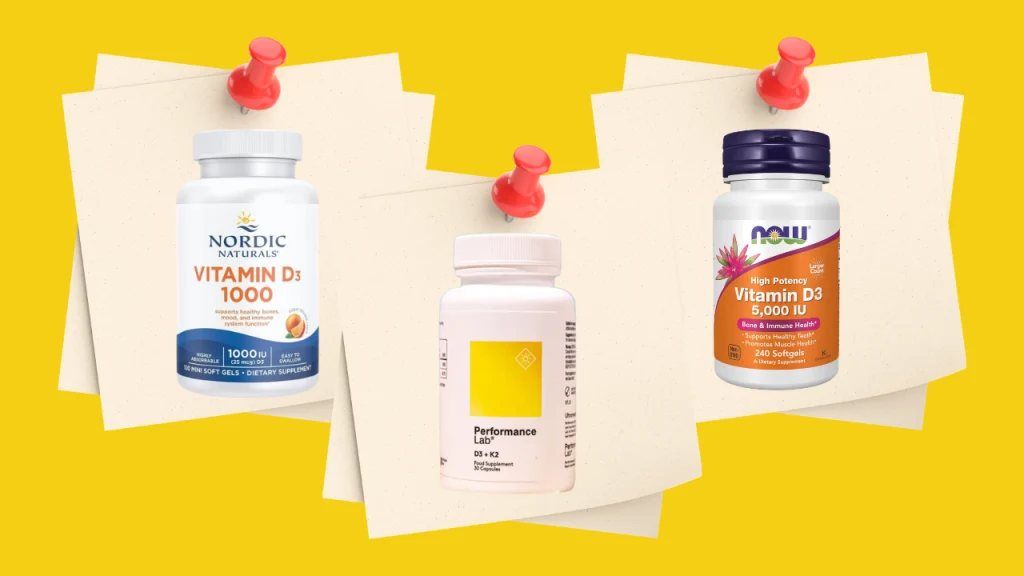
- Best vitamin D supplement for most adults: Nordic Naturals Vitamin D3 1000. It delivers 1,000 IU vitamin D3 in organic extra-virgin olive oil in a small daily softgel, and Yahoo’s review highlighted the brand’s transparency around testing results.
- Best vitamin D3 + K2 supplement: Performance Lab D3 + K2. You get a moderate 1,000 IU D3 + 50 mcg K2 dose in a vegan capsule with a notably clean-label presentation.
- Best vitamin D3 5000 IU supplement: NOW Vitamin D3 5000 IU Softgels. Strong value, olive-oil softgel delivery, and broad manufacturing credentials make it a smart high-dose option for people who actually need that category.
- Best vitamin D3 10000 IU supplement: Sports Research Vitamin D3 10000iu. This is a max-strength pick with MCT oil, third-party testing, and a straightforward formula—but it is not an everyday default for the average shopper.
- Best liquid vitamin D supplement: Thorne Vitamin D + K2 Liquid. This one is great for people who hate pills and want drop-by-drop flexibility.
- Best gummy vitamin D supplement: Nature Made Zero Sugar Vitamin D3 Gummies. A useful compliance-friendly option with USP Verified quality verification.
- Best hypoallergenic high-dose alternative: Pure Encapsulations Vitamin D3 & K2. A solid choice if you want a cleaner high-dose capsule and pay close attention to allergens and excipients.
DISCLOSURE: We earn commissions for purchases made through links in this post. As an Amazon Associate, we earn from qualifying purchases. However, we only recommend products and services we genuinely believe in and consider valuable to our readers.
Best vitamin D supplement for most adults: Nordic Naturals Vitamin D3 1000

If I were choosing one product for the broadest group of readers, I would land on Nordic Naturals Vitamin D3 1000. Its biggest advantage is balance. The official product page lists 25 mcg (1,000 IU) of vitamin D3, an easy-to-swallow mini softgel, and organic extra-virgin olive oil as the carrier. That makes it a much more sensible “most adults” pick than a bottle that starts at 5,000 IU or 10,000 IU.
I also like that this formula stays simple. You are not paying for a kitchen-sink blend you may not need. Yahoo’s testing-based roundup called Nordic Naturals its best daily vitamin D supplement and noted that the brand makes testing results available online, which is exactly the kind of transparency I want to see in a category where labels can otherwise blur together.
This is the pick I would point to for someone searching best vitamin D3 supplement because they want a clean, maintenance-friendly daily option, not a therapeutic megadose.
Best vitamin D3 + K2 supplement: Performance Lab D3 + K2
For the best vitamin D3 + K2 supplement category, Performance Lab D3 + K2 earns the slot because it takes a different—and, for many readers, smarter—approach than the usual “more is better” formula. The current label provides 25 mcg vitamin D3 (1,000 IU) plus 50 mcg vitamin K2, with a vegan capsule and a very short ingredient list. The product page also notes that it is free from soy, peanut, tree nuts, wheat, gluten, artificial additives, colors, and preservatives, and it displays Vegan Approved, Clean Label Project Certified, and GMP Certified Manufacturing badges.
Why does that matter? A lot of D3 + K2 products jump straight into higher doses that may be unnecessary for someone who simply wants an everyday combo formula. Performance Lab’s moderate dose makes more sense for a broad audience that wants a clean-label daily capsule and specifically likes the idea of combining D3 with K2. The caveat is an important one: vitamin K can interact seriously with warfarin and similar anticoagulants, so anyone on those medications should not casually switch into a D3 + K2 formula just because it sounds more complete.
If you want a stronger D3 + K2 softgel instead of a moderate vegan capsule, Sports Research Vitamin D3 + K2 is the logical runner-up. Yahoo named it its best overall vitamin D supplement, and the current official page lists 5,000 IU D3 + 100 mcg K2, coconut MCT oil, and third-party testing—but that higher dose makes it less universally appropriate than Performance Lab in an “everyone is searching this” article.
Best vitamin D3 5000 IU supplement: NOW Vitamin D3 5000 IU Softgels
If you specifically want the best vitamin D3 5000 IU supplement, NOW Vitamin D3 5000 IU Softgels is the highest-value answer in this lineup. The official page shows 125 mcg (5,000 IU) per softgel, delivered in extra virgin olive oil, with clear usage instructions to take it with a fat-containing meal. The same page also lists halal, kosher, non-GMO, and Intertek GMP Supplement Certification markers, along with a wide range of bottle sizes.
The reason this product works so well for the 5,000 IU category is that it is straightforward. No flashy add-ons. No inflated positioning. Just a recognizably established brand, a fat-based softgel, and a very strong price-per-serving profile. Forbes also highlighted NOW’s vitamin D line as a standout because it comes in multiple dosages and formats, which matters when you want room to scale up or down without changing brands entirely.
That said, 5,000 IU is already above the adult tolerable upper intake level of 4,000 IU per day from the NIH. In practice, people do use this level under clinician guidance when they have low labs or limited sun exposure, but it is not the bottle I would hand to every casual shopper by default. If your goal is basic daily maintenance, stick with the more moderate categories instead.
Best vitamin D3 10000 IU supplement: Sports Research Vitamin D3 10000iu
For readers who are explicitly searching best vitamin D3 10000 IU supplement, the most practical pick here is Sports Research Vitamin D3 10000iu. The official page lists 250 mcg (10,000 IU) per softgel, coconut MCT oil, third-party testing, and non-GMO and gluten-free positioning. If you truly need a max-strength D3 product, that is a clean and credible starting point.
But this category needs a brighter warning label than almost any other part of the article. A 10,000 IU product is not a casual wellness purchase for most people. The NIH says excessive vitamin D from supplements can cause high blood calcium, with symptoms including nausea, weakness, excessive thirst, kidney stones, and—in severe cases—kidney failure and heart rhythm problems. High-dose products belong in the conversation mainly for readers who have already had labs reviewed or have a clinician-defined reason to use them.
If you want a more conservative max-strength alternative with a very detailed usage note, NOW Vitamin D3 10,000 IU Softgels is another strong option. The current page lists 10,000 IU, olive oil, and a suggested usage of one softgel every 3 days with a fat-containing meal, which is a more nuanced instruction than “just take one daily forever.”
Best liquid vitamin D supplement: Thorne Vitamin D + K2 Liquid
Some people are never going to take a capsule consistently. For them, the best liquid vitamin D supplement is a much better search path than endlessly comparing softgels. Thorne Vitamin D + K2 Liquid stands out because the product details show 25 mcg vitamin D3 plus 200 mcg vitamin K2 per 2 drops, making it easy to take, easy to mix into food or a drink, and easy to use if swallowability is your main issue.
Healthline also singled this formula out in its roundup because it is one of the few options that combines vitamin D with K2 in a liquid format and can be mixed into food or beverages. That makes it especially appealing for people who share supplements within a household or who simply know they are more consistent with drops than pills. As with any K2-containing formula, though, it is not the right choice if you are on warfarin unless your clinician specifically wants you there.
Best gummy vitamin D supplement: Nature Made Zero Sugar Vitamin D3 Gummies
There are plenty of people who would do better with a gummy they actually remember than with a “perfect” capsule they skip six days a week. In that lane, Nature Made Zero Sugar Vitamin D3 Gummies is the clear winner for me. The official page lists 2,000 IU (50 mcg) per 2 gummies, zero sugar, and a visible USP Verified mark. Yahoo also chose this product as its favorite gummy option.
The USP piece matters. Gummies are convenient, but they are not always the form people trust most when it comes to potency consistency. Nature Made’s USP verification gives this pick a legitimacy boost that most gummies do not have. So if your search is basically “I need the best vitamin D supplement I’ll actually take,” and chewables are what make that happen, this is a very defensible answer.
Best hypoallergenic high-dose alternative: Pure Encapsulations Vitamin D3 & K2
Some readers care less about flavor or format and more about purity, excipients, and allergen profile. For them, Pure Encapsulations Vitamin D3 & K2 is worth serious consideration. Retail descriptions for the current formula list 4,000 IU vitamin D3 plus 100 mcg MK-7 vitamin K2, while Pure Encapsulations’ own pages emphasize that the brand is made without many common allergens and unnecessary additives.
This is the pick I would put in front of someone who wants a relatively clean, capsule-based, higher-dose D3 + K2 formula and is the kind of shopper who reads every inactive ingredient before buying. The trade-off is obvious: 4,000 IU is already the adult upper limit cited by NIH, so this is not your “why not?” bottle. It is a targeted option for people who know why they are shopping in that range.
Do you actually need a vitamin D supplement
Not always—but often enough that the category matters. The NIH says very few foods naturally provide much vitamin D, fortified foods make up most vitamin D intake in the U.S., and your body can make some vitamin D from sun exposure. Still, it also notes that older age, dark skin, limited sun exposure, fat malabsorption, obesity, and gastric bypass surgery can all raise the risk of low vitamin D status.
The more nuanced question is whether you need routine testing or routine supplementation. The 2024 Endocrine Society guideline suggests against routine 25(OH)D testing in healthy adults and against routine supplementation in the general 50–74 population beyond the standard Dietary Reference Intakes. At the same time, it suggests supplementation for certain groups, including people over 75, pregnant individuals, and adults with high-risk prediabetes. In plain English: the answer is not “everyone should take a megadose,” but it is also not “nobody needs a supplement.”
If you have symptoms, very low sun exposure, a known deficiency, or a condition that affects absorption, a supplement can make a lot of sense. If you are healthy and just trying to play defense, a modest vitamin D3 supplement is usually the more rational place to start than a 10,000 IU product.
Vitamin D2 vs D3 and does K2 matter
For most supplement shoppers, D3 is the better form to prioritize. The NIH states that both D2 and D3 can raise blood vitamin D levels, but D3 may raise them higher and for longer. A more recent systematic review and meta-analysis also concluded that vitamin D3 is generally more potent than D2 for raising serum 25-hydroxyvitamin D concentrations, even though the size of the difference varies by dosing pattern and other factors.
K2 is a little more nuanced. Mechanistically, the combination makes sense: vitamin D helps your body absorb calcium, while vitamin K-dependent proteins are involved in calcium handling in bone and vascular tissues. NIH’s vitamin K material and review literature both support the idea that vitamins D and K are biologically linked in calcium metabolism. But NIH also notes that the role of vitamin K in arterial calcification and coronary heart disease risk is still an active area of research, not a settled clinical commandment for every supplement shopper.
That means D3 + K2 formulas can be a smart category, especially for readers who want a bone-focused combo and are not on anticoagulants. But a plain best vitamin D3 supplement can still be the better answer for someone who wants a simpler formula or wants to avoid K interactions.
How much vitamin D should you take
The NIH recommendations are straightforward: 600 IU daily for adults 19–70, 800 IU daily for adults 71 and older, and an upper limit of 4,000 IU daily for ages 9 and up unless a healthcare professional directs otherwise. That is why a product with 1,000 IU or 2,000 IU often makes more sense as an “everyday” answer than a 5,000 IU or 10,000 IU formula.
Higher doses do exist for a reason. If your labs are low or your clinician wants faster correction, 5,000 IU products may have a role, and the Endocrine Society guideline also suggests that for adults 50+ who need vitamin D treatment, daily lower-dose vitamin D is preferable to intermittent higher-dose dosing. But that is still a clinical decision, not a license to self-prescribe the strongest label on the shelf forever.
As a practical shopping rule:
A 1,000 IU to 2,000 IU formula is the most logical lane for everyday maintenance.
A 5,000 IU formula is a more deliberate, often labs-driven category.
A 10,000 IU formula is a niche tool, not a default.
How to choose the right vitamin D supplement
Start with the dose, not the branding. If you do not already know you need a high-potency supplement, begin by looking at 1,000 IU to 2,000 IU products before you even entertain the 5,000 IU or 10,000 IU pages.
Then look at the form. Because vitamin D is fat-soluble, softgels or liquids that include oil—or products you can take with a meal containing fat—make the most practical sense. NIH specifically notes that vitamin D is best absorbed with a meal or snack that includes some fat.
After that, check the trust signals. Since supplements are not FDA-approved before sale, look for some combination of USP verification, NSF-style certification, third-party testing, or unusually clear manufacturing transparency. If you have dietary restrictions, read the inactive ingredients just as closely as the dose. And if you are on warfarin or similar anticoagulants, treat any D3 + K2 formula as a conversation with your clinician, not an impulse add-to-cart.
How Syktohealth Selects Supplements
At Syktohealth, our supplement reviews are guided by a science-driven and safety-first methodology developed through ongoing research and industry analysis. Each product we feature is carefully evaluated based on:
- Scientific and clinical evidence supporting the supplement’s ingredients and intended benefits
- Appropriate ingredient dosages aligned with current research and established guidelines
- Manufacturing quality and safety standards, including third-party testing and GMP compliance when available
- Full ingredient transparency, avoiding unnecessary fillers, artificial additives, or misleading proprietary blends
- Overall value and formulation quality, not marketing claims or paid promotion
Our content is independently researched and regularly updated to reflect new scientific findings. We do not accept compensation in exchange for positive reviews, and our recommendations are never influenced by advertisers.
You can read more about our Dietary Supplement Methodology here.
Why Trust Syktohealth?
Syktohealth is committed to delivering independent, evidence-based health and supplement reviews you can rely on. Our content is created and reviewed using a structured editorial process designed to prioritize accuracy, safety, and transparency.
You can trust Syktohealth because:
- All supplement reviews are grounded in scientific evidence, including peer-reviewed research and established medical and nutrition guidelines
- Content is medically reviewed by Ali Webster, PhD, RD, Senior Medical Reviewer — a board-certified physician with over 15 years of clinical experience in preventive medicine and metabolic health
- Editorial independence is strictly maintained—we do not accept payment for favorable reviews or product rankings
- Safety and ingredient transparency are prioritized, especially for supplements that may impact health outcomes
- Articles are regularly reviewed and updated to reflect the latest research, clinical guidelines, and safety information
Our mission is to help readers make informed, confident health decisions based on credible expertise—not marketing influence.
FAQs
Which is better, vitamin D2 or D3?
For most people buying a supplement, vitamin D3 is the better pick. NIH says D3 may raise blood vitamin D levels higher and for longer than D2, and recent review evidence points in the same direction.
When is the best time to take vitamin D supplements?
The timing matters less than the context. The main thing is to take vitamin D with food that contains some fat, because that improves absorption. That means breakfast, lunch, or dinner can all work as long as the habit is consistent.
Can I take 5,000 IU of vitamin D every day?
You can, but that does not mean you should do it casually. 5,000 IU exceeds the NIH upper limit of 4,000 IU for adults, so it makes more sense as a clinician-guided or lab-driven choice than as a random maintenance dose.
Is 10,000 IU of vitamin D too much?
For many people, yes. A 10,000 IU product is a specialty category, not a general wellness recommendation. Long-term overuse raises the risk of vitamin D toxicity and hypercalcemia, so this is a “use with guidance” tier.
Do I need vitamin K2 with vitamin D?
Not necessarily. A plain D3 product can be an excellent choice. D3 + K2 combos are most interesting for people who specifically want that pairing and are comfortable with the added medication considerations. If you take warfarin or similar anticoagulants, do not self-prescribe K2.
Final verdict
If you want the best vitamin D supplement for most adults, choose Nordic Naturals Vitamin D3 1000. It is measured, practical, and easy to take. If your search is really for the best vitamin D3 + K2 supplement, go with Performance Lab D3 + K2 for a cleaner, moderate-dose vegan capsule. If your needs are truly higher, NOW Vitamin D3 5000 IU is the best value play in that bracket, and Sports Research Vitamin D3 10000iu is the strongest max-potency pick in this article—but only for readers who actually belong in that high-dose conversation.
That is the real takeaway: the best vitamin D supplement is not the strongest bottle on the page. It is the product whose dose, form, testing profile, and ingredient list actually match your reality.

Ali Webster is a seasoned researcher, communicator, and Registered Dietitian with a diverse background encompassing government, nonprofits, academia, and health care. The core belief is that science should be made accessible, understandable, and relevant to all individuals, driving the motivation behind their work. Proficient in conducting and interpreting research to shape nutrition policy decisions, the individual also excels in nutrition and health communication, consumer research survey development and implementation, and clinical nutrition. Holding a Doctorate of Philosophy with a focus on Nutrition and Epidemiology from the University of Minnesota, their dietetic internship emphasized medical nutrition therapy.